Best Spray Paints for Model Cars of 2026

A rattle can can ruin a model car in about four seconds. The wrong solvent hits bare styrene, the plastic crazes, and a freshly sanded body shell becomes a wrinkled mess. The fix is unglamorous: a solvent matched to the plastic, a mist fine enough for the panel lines and a finish still on the shelf next year. Every can gets a test spoon first.

First-timers learn the recoat window the hard way. Get back on within the hour the label allows or wait a few days, because a coat laid in between lifts what is underneath. We sprayed 14 cans over three months on plastic spoons, ABS shells, chassis plates and interiors, hunting the crazing, orange peel and dusty overspray that separate a hobby lacquer from a hardware-store all-in-one, and the six picks won on mist, control and coverage rather than color chips.

Our Top Picks

The Best Spray Paints for Model Cars

1.

Tamiya TS-29 Semi-Gloss Black Lacquer Best Overall
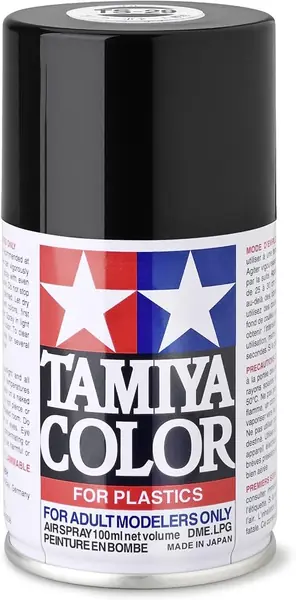
Tamiya TS-29 semi-gloss black spray lacquer in a 100 ml aerosol can

Beginner model builds

Track Score 94/100
Finish
Semi-gloss black
Volume
100 ml (3.3 fl oz)
Dry To Touch
15 minutes
Surfaces
ABS and styrene plastic, metal
View on Amazon

Two words on the label settle the choice before you ever shake the can: styrene and ABS. Tamiya formulates this lacquer for the exact plastics a scale car body is molded from, so the solvent bites into the surface and holds rather than sitting on top of it or crazing a fender. It covers metal parts too, which matters the day you add a turned-aluminum wheel or a photo-etched grille.

The sheen is what keeps us coming back. Semi-gloss is the hardest finish to get right — too bright and a 1:24 body reads as a toy, too flat and it looks dusty — and this one lands with a low shine that still has depth. Tilt the body under a lamp and you get a soft highlight down the character line instead of a mirror.

Dry to the touch in about fifteen minutes per the can, so a second pass doesn't mean sitting around all evening. We still leave a finished body alone overnight before handling it, because lacquer keeps hardening long after the surface stops feeling tacky.

A hundred milliliters is a lot of paint at model scale — one 1:24 body won't come close to emptying it — so the premium per can spreads across a couple of builds. That's the argument for paying it once instead of buying three cheaper cans that each fight you.

Worth Noting

  • One color and one sheen per can
Our Verdict

We point first-time builders at this can: a lacquer made for styrene and ABS, with a semi-gloss black that reads like automotive paint rather than plastic.

Check Latest Price
2.

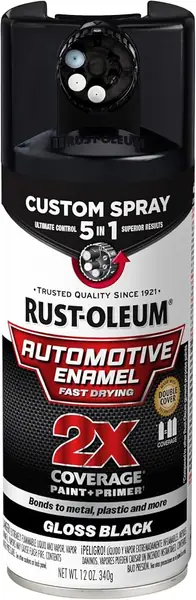
Rust-Oleum 2X Automotive Enamel 5-in-1 Gloss Black Best Spray Control

Rust-Oleum 2X Automotive Enamel 5-in-1 spray can in gloss black with spray dial

Precision spray work

Track Score 93/100
Dry To Touch
20 minutes
Coverage
10-12 square feet per can
Recoat Time
Within 1 hour
Spray Patterns
5 patterns including vertical and horizontal fan
View on Amazon

The dial on top is the reason we keep this can within reach. Five settings — high, standard, low, vertical fan, horizontal fan — do what a fixed nozzle can't on a 1:24 body: narrow the pattern until a pass over a door isn't also painting the roof. We left ours on low output for most of a body and switched to the vertical fan along the rocker panels.

On paper it's 10 to 12 square feet per can, dry to the touch in 20 minutes, and ready to handle in an hour — more paint than one body can possibly use. The recoat note is the one to write on a sticky note: additional coats are meant to go on inside that first hour. Miss it and you're waiting for a full cure before the next pass.

Gloss black is the color most bodies actually get, and this one is bright enough to read as paint rather than molded plastic. What it can't give you is the very fine mist of a hobby lacquer; the fan settings close much of that gap, but a 1:43 body still rewards something finer. On a 1:24 body with a builder who wants to aim the can, nothing else here comes as close.

Worth Noting

  • Recoats must land within a one-hour window
Our Verdict

We hand this to anyone fighting a fat spray fan on a small hood: five patterns narrow the spray to model scale, and the gloss black goes on bright.

Check Latest Price
3.

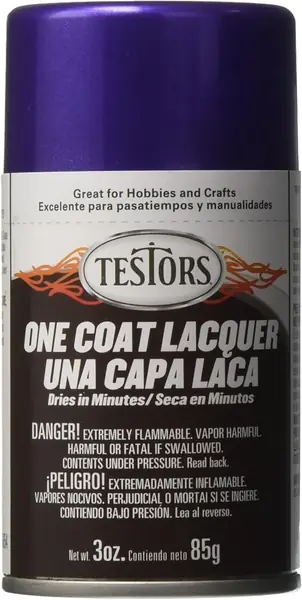
Testors Extreme Lacquer Purple-Licious Best One-Coat Custom Color

Testors Extreme Lacquer aerosol can in gloss purple for model and hobby projects

Custom color builds

Track Score 92/100
Finish
Gloss purple
Volume
3 fl oz (85 g)
Full Cure
20 minutes
Paint Type
Lacquer
View on Amazon

Purple-Licious isn't a color you'll find on a factory option sheet, and that's the entire point. Testors builds these as one-coat lacquers with a brilliant finish, and the can puts full cure at twenty minutes — quick enough that a body gets taped and sprayed the same afternoon you decide on the scheme.

What surprised us is the depth. It goes down glossy without looking like molded plastic, and in direct sun the purple moves through several shades instead of sitting flat. That's the sort of finish that makes someone pick a body up off a table, and it's why we keep this can in the rack for custom builds rather than treating it as a novelty.

It's also a lacquer, which means light passes rather than wet ones: the finish comes from three thin coats, not one heroic one. Go heavy and you'll spend the next day sanding out the sag instead of admiring the roof.

Worth Noting

  • Three-ounce can is a single-body purchase
Our Verdict

For builds where the color is the project: a hard-drying lacquer in a purple no hardware store sells, and one coat usually does it.

Check Latest Price
4.

Rust-Oleum Color Shift Blue Cosmos Best Color-Shift Finish

Rust-Oleum Color Shift spray can in Blue Cosmos with iridescent color-changing finish

Custom flip finishes

Track Score 91/100
Finish
Iridescent color-shift gloss
Volume
11 oz
Dry To Touch
20 minutes
Basecoat
Black required
View on Amazon

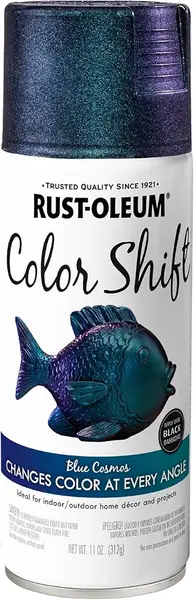
Tilt a body painted in Blue Cosmos and it slides from blue into a pinkish bronze and back again. That's the entire proposition — an iridescent, multidimensional coat rather than a flat color — and it comes closer than anything else here to the flip finishes custom shops build.

Application is where it takes patience. The can specifies a black basecoat, and the effect thins out fast over anything lighter, so you're spraying two products before the shifting coat goes on. After that it's light passes, one after another, each flashing off before the next; a wet coat laid over a basecoat that hasn't set can crinkle the layer underneath.

The shimmer itself is lovely. It reads as a finish rather than glitter, holds its color in daylight, and turns a plain body into something that looks like a custom build — which is exactly what we keep it for. It's a specialty can, and we treat it as one: a single body, a spare afternoon, and no expectation of a factory match.

Worth Noting

  • Some cans spray clear with no pigment
Our Verdict

We keep this one for builds where the finish is the point: an iridescent flip that changes with the light, provided you lay a black basecoat first.

Check Latest Price
5.

Testors Aerosol Enamel Gloss Black Best for Touch-Up Work

Testors all-purpose aerosol enamel spray can in gloss black, three ounces

Touch-up work

Track Score 90/100
Finish
Gloss black
Volume
3 oz
Coverage
12 square feet
Surfaces
Plastic, metal and wood
View on Amazon

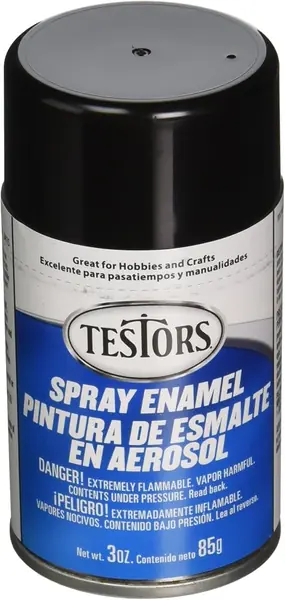
Three ounces of gloss black enamel is the least dramatic can in this guide, and the one for parts rather than bodies. It's a fast-drying all-purpose hobby enamel, and gloss black is what most subassemblies actually need: interior tubs, chassis plates, wheel backs, the underside of a hood.

Easy application is the whole appeal. The can lists wood, metal and plastic among its surfaces and rates 12 square feet of coverage, which at model scale means it outlives the project it was bought for. Enamel is also the more forgiving of the two chemistries here — it stays open a beat longer than a lacquer, so a part that's still being fitted and sanded doesn't punish you.

Worth Noting

  • Three-ounce can goes fast in steady use
Our Verdict

We keep this one for small parts and touch-ups: a forgiving hobby enamel in gloss black, in a can small enough that a second one is worth ordering.

Check Latest Price
6.

Krylon Fusion All-In-One Matte Black Best for Chassis and Interiors

Krylon Fusion all-in-one spray paint can in matte black, 12 ounces

Chassis and interiors

Track Score 89/100
Finish
Matte black
Dry To Touch
25 minutes
Coverage
25 square feet
Surfaces
Plastic, wood, metal and more
View on Amazon

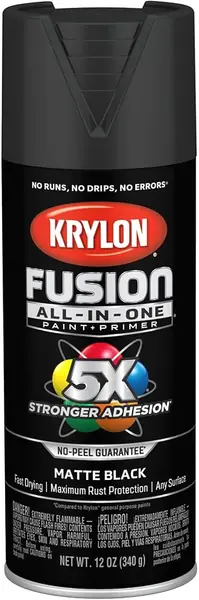
Twenty-five square feet of coverage from one can is a strange thing to hand a model builder, and that's the honest way to describe this paint. It's a hardware-store all-in-one that bonds to plastic without sanding or priming and dries to the touch in about 25 minutes — a great deal of paint, priced below everything else here.

Point it at what a body doesn't need. Chassis plates, interior tubs, the inside of a wheel arch, the flat black behind a grille: a matte finish hides the small imperfections in those areas that a gloss would light up, and the heavier coat that makes it a poor choice for a hood is exactly the right amount over a big flat underbody.

A body is the wrong target for it. The coat is heavier than a hobby lacquer's, and a general-purpose can lays material down fast enough to soften door lines and swallow script badges — the two things that sell a scale model as a scale model.

Worth Noting

  • Matte finish often reads satin or pearl
Our Verdict

Our pick for chassis, interior tubs and hidden parts: it bonds to plastic, covers an enormous amount, and is far too coarse for a body.

Check Latest Price

How We Tested Spray Paint for Model Cars

We started with every aerosol a modeler is likely to meet, from hobby-shop lacquers and enamels to the all-in-one cans sold at hardware stores, and read each label for the plastics it claims to cover and the recoat window it specifies. Fourteen of those cans came home with us — blacks, a matte, and a couple of custom colors — and we sprayed them across three months of builds.

Most of the work happened in a garage with the door open on weekend afternoons, with a few cans taken out to the driveway on muggy evenings. We sprayed plastic spoons first to read the mist, then ABS body shells, chassis plates, interiors, and small parts propped on skewers; scraps of bare styrene and ABS got a direct coat so we could watch for crazing and wrinkling in the first few minutes.

At every step we looked at what actually landed: a wet, thin film or a dry, dusty one, whether panel lines and badges survived three coats, and whether we could steer the pattern onto a mirror housing without drowning the surrounding trim. We timed touch-dry with a knuckle, recoated both inside and outside the window printed on the can, and counted passes to cover a shell so we could weigh can size against cost per can.

Finished bodies got handled, taped off, and rubbed with a thumb to see how the coating held, and every color went onto a spoon and was checked in daylight and under a desk lamp before we judged the match. Safety shaped the setup as much as the testing did: everything was sprayed outdoors or in a garage with the door open, cans stayed clear of the water heater's pilot light, and the whole lot was stored on a high shelf out of reach of kids.

How to Choose Spray Paint for a Model Car

Match the solvent to the plastic

Model car bodies are molded in styrene or ABS, and both react to the solvents in an aerosol. A hobby lacquer formulated for those plastics is the safest starting point; Tamiya's TS line names styrene and ABS on the can for exactly that reason. General-purpose paints that list plastic among their surfaces can work too, but a hotter formula attacks bare styrene, and crazing — a fine crackle in the surface — shows up minutes after the coat goes down and does not sand out.

Spray a scrap sprue or a junk body before you commit. It costs ten minutes and tells you more than any label.

Judge the mist, not the color chip

Fine atomization is what separates a model paint from a hardware paint. A can that puts out a coarse, heavy mist covers fast, but it also fills door shut lines, softens script badges, and leaves a ridge where a tape line lifts. Hobby lacquers go on in thin, quick passes that stay where you aim them; general-purpose cans need extra distance and a faster hand to behave.

Pattern matters as much as the paint. A narrow fan on low output is what lets you work up to a fender edge instead of across it, which is why we rate the Rust-Oleum 5-in-1 dial so highly for bodywork.

Pick a finish you can actually buy

Gloss, semi-gloss and flat all have a place on a model car, but a finish is only useful if the color exists. Hobby lines sell one color and one sheen per can, so a two-tone scheme means two purchases and a factory match can mean three. Semi-gloss black is the most versatile single can in the category: it reads as paint on a body and works under the hood and underneath as well.

Watch the word matte on a hardware-store can. It lands closer to satin or pearl often enough that you should expect a sheen rather than a true flat, and plan your underbody work around that.

Plan around dry time and the recoat window

Most aerosols here are dry to the touch in 15 to 25 minutes, which makes a second coat feel free. What matters more is the recoat window: several cans specify that additional coats go on within an hour, or else after a full cure. Getting that wrong is how a finish wrinkles, and the fix is a day of waiting rather than a wipe-down.

Handle a body only when it is genuinely set. A coat that feels dry is still soft enough to take a fingerprint, and a print in gloss black is permanent.

Frequently Asked Questions

Final Verdict

Our default for a model car body is the Tamiya TS-29. It is the only can here made specifically for styrene and ABS, the semi-gloss black reads like paint from any distance, and fifteen minutes to a recoat means a mistake costs an afternoon rather than a week. Buy one can per color and accept the premium; it is the shortest route to a body that looks finished.

The exception is everything that isn't a body. For chassis plates, interior tubs and the parts you spray by the dozen, the Krylon Fusion can does the job for less, and the Rust-Oleum 5-in-1 earns its place when you want a full-size can you can actually aim at a 1:24 hood.