Best RC Rally Cars of 2026

The box says 50 mph, and on clean asphalt that number is real. It doesn't say whether the car stays pointed forward when a gravel rut grabs a front wheel, or whether the drivetrain is still full of grit two weekends later. A good rally car has real ground clearance, shocks that absorb washboard instead of launching off it and sealed electronics.

The most fun cars weren't the fastest. A gyro flatters a car more than a few extra mph, and a second battery pack shapes a session more than the ESC rating does. We ran nine cars in an empty school lot on Sunday mornings, on a rutted service road and on wet grass after rain, and the six picks, all rated 14 and up, cover a first hobby car, a kit for the builder and a small car for tight spaces.

Our Top Picks

The Best RC Rally Cars

1.

RIAARIO 1/10 Brushless Rally Car Best Overall
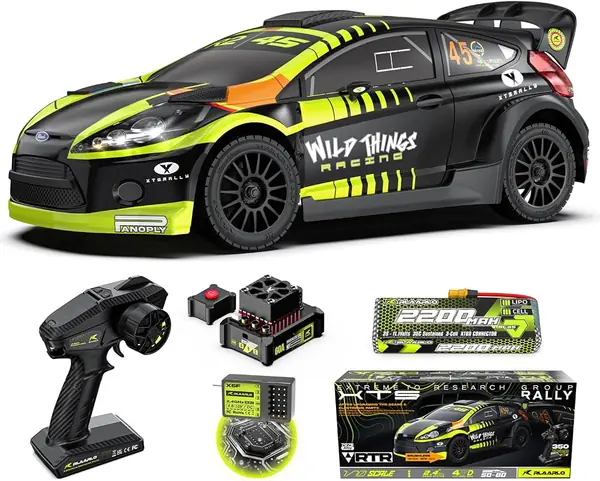
RIAARIO 1/10 black brushless RC rally car with clear polycarbonate body shell

All-round rally driving

Track Score 90/100
Scale
1:10
Motor And ESC
2852 3800KV brushless, 45A waterproof ESC
Top Speed
50 mph
Chassis
2.5 mm 6061 aluminum
View on Amazon

Gravel kills a rally car from the inside. It works past the seals, finds the differential, and turns a smooth drivetrain into a box of grit, which is why sealed differentials and the 2.5 mm 6061 aluminum chassis plate are the two specifications we check first. That plate is stiff enough to take a square hit on a rutted track, and the seals keep the worst of the surface where it belongs. It is the combination that earns this car the top spot for mixed-surface running.

The suspension is set up the way a rally car should be: oil-filled shocks, CNC-machined shock towers, and front and rear anti-roll bars, so the car settles instead of skipping when the surface changes under it. It sits low out of the box, as cars that also have to work on pavement do, and raising the ride height before your first gravel run is worth the ten minutes. The steering servo is a micro-size unit rather than a standard 1/10 part; it holds up fine, and it is the first thing to swap if you want sharper turn-in.

Electronics are where this car separates from the cheaper 1/12s. The speed control is a 45A waterproof unit, the 3800KV motor runs on the included 3S pack to about 50 mph, and the five-channel transmitter reaches roughly 350 meters, which is more range than any rally course needs. Clipless body locks mean you can change a pack without hunting for pins, and the dual receiver boxes leave room for lights or a second servo later.

Set against the CROBOLL below, it gives away the last few mph and the bigger speed control; what it keeps is a drivetrain we trust on loose ground, and we don't have a serious complaint about it. The one buyer to steer elsewhere is anyone planning to run indoors: at 1/10 scale and 7.25 lb, this car wants a lot, not a hallway.

Our Verdict

For gravel, dirt, and the pavement in between, we point most people here: sealed diffs, a 2.5 mm aluminum chassis, and 3S power that stays controllable.

Check Latest Price
2.

CROBOLL 1/10 Brushless Rally Car Best for Top-Speed Runs

CROBOLL 1/10 green brushless RC rally car with carbon fiber chassis and rear wing

Fastest

Track Score 89/100
Scale
1:10
Motor And ESC
3650 3300KV brushless, 60A ESC
Top Speed
50 mph
Radio
5-channel, about 350 m, with gyro
View on Amazon

Sixty amps of speed control and a 3650 motor is a lot of electronics for a 1/10 rally car, and CROBOLL cools both with fans and a metal heatsink so the power doesn't fade halfway through a pack. Top speed is quoted at 50 mph on the included 3S battery, and the internals back it up: chrome steel helical gears in the spur, input, and differential, plus dampening rings on the center driveshaft couplings to take the shock out of landings.

We like it for exactly what it is, the fastest car in this group and the one that feels most like a purpose-built speed machine rather than a rally car that also happens to be quick. The five-channel radio reaches about 350 meters, and the gyro does real work at the top of the throttle, correcting the small inputs that would otherwise put a 50 mph car into a curb. Its natural home is a long, smooth lot rather than a rutted trail.

Upgradability is the quiet argument for this one. The dual ESC tray and dual receiver box are there so a bigger speed control or a second receiver bolts in without drilling, and the steering servo is a standard-size part, so an upgrade is a swap rather than a hunt for an oddball. Check the cable routing to the power switch before your first run, since it sits where debris can reach it. Otherwise this car rewards what you put into it.

Worth Noting

  • Tires wear quickly under full-throttle asphalt running
Our Verdict

If outright speed is the point, this is the car: a 60A system and a gyro that keep 50 mph pointed straight.

Check Latest Price
3.

DIKAVEY RX12 1/12 Rally Car Best Value

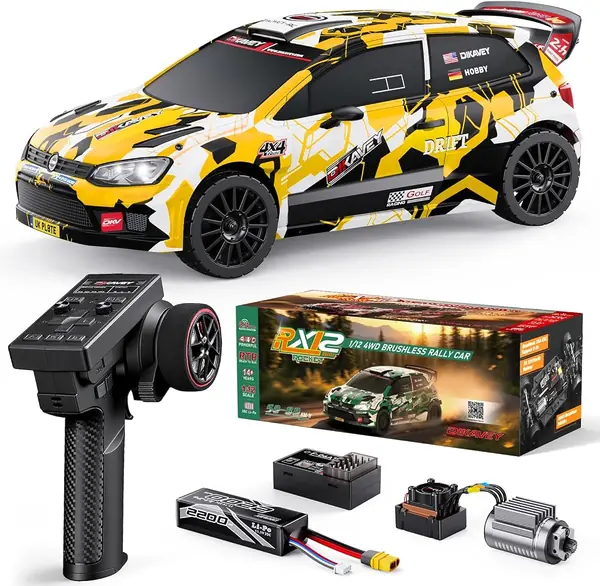
DIKAVEY RX12 1/12 yellowish-white brushless rally car with aluminum chassis and lights

First hobby car

Track Score 88/100
Scale
1:12
Motor And ESC
2845 3600KV brushless, 35A ESC
Top Speed
50 mph
Battery
3S 2200 mAh LiPo
View on Amazon

The cheapest car here with a full metal drivetrain, the RX12 doesn't read like the budget option. A CNC steel differential, steel CVDs, and oil-damped suspension sit inside a 6061 aluminum chassis, which is the same material the two 1/10 cars above use. At 2.65 lb and 1/12 scale it also fits a driveway or a small lot that a 1/10 car would cross in two seconds.

Power comes from a 35A speed control and a 2845 3600KV motor, both fan-cooled, on the included 3S 2200 mAh pack. The gyro does the same job it does on the bigger cars, correcting the small stuff so 50 mph stays a straight line, and the protection layer is more than marketing at this size: low-voltage cutoff and over-temperature warnings save packs and speed controls that would otherwise cook. It runs warm in long sessions, so let it idle a minute with the fan running before you switch off.

Where it earns its place is hardware per dollar, because nothing else in this group puts a metal drivetrain and a gyro at the bottom of the price range. It is also the car we point at someone stepping up from a toy-grade truck, since the 1/12 footprint keeps 50 mph manageable in a space that isn't a permanent track. Give it a cooldown lap between packs; the fans are there because the electronics work hard.

Worth Noting

  • Gear motor can strip under hard use
  • Light wiring is untidy and exposed
Our Verdict

The least expensive way into a metal drivetrain and a gyro here, and quick enough at 50 mph to stay interesting.

Check Latest Price
4.

MJX Hyper Go 14303 1/14 Rally Car Best for Small Spaces

MJX Hyper Go 14303 1/14 Citroen C3 rally car with metal shocks and rear wing

Tight spaces

Track Score 87/100
Scale
1:14
Motor And ESC
2845 brushless, 45A ESC
Top Speed
42 km/h on the included 2S pack
Radio Range
120 m
View on Amazon

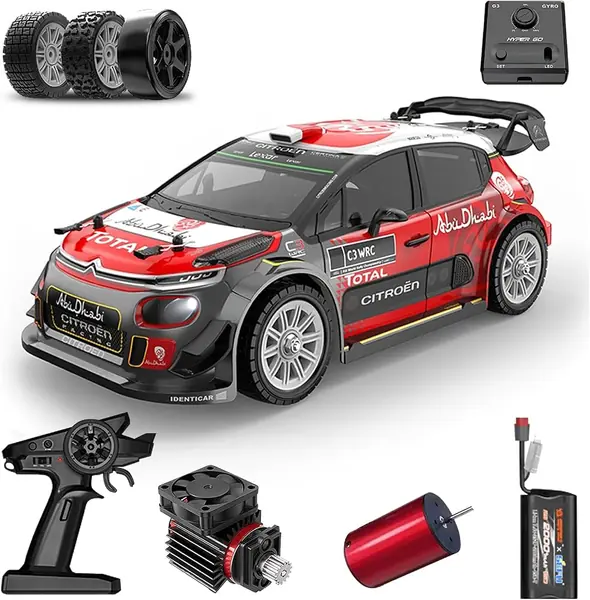
Fourteen-scale is the difference between a rally car you drive and one you watch. The Hyper Go 14303 is a Citroen C3-bodied car small enough to run a slalom in a two-car driveway, with a 45A speed control and a 2845 brushless motor that put down 42 km/h on the included 2S pack, and noticeably more once you fit the 3S battery it is built to take.

We're pleasantly surprised by how much car is packed into the small scale. The shocks are full metal hydraulic units rather than the friction dampers this size usually gets, and a standalone receiver means a radio upgrade doesn't mean a new car. Over pavement, dirt, and small gravel it stays pointed where you aim it, and the 120-meter range is plenty, because you'll run out of clear line of sight before you run out of radio.

Tires are the consumable to plan for: a light 1/14 car on 3S spins them up and wears them flat, so a spare set belongs in the same order as the car. Beyond that, the detail is what we noticed, a properly proportioned Citroen C3 rally shell with molded light details that looks right sitting still as well as moving.

Worth Noting

  • 3S battery sold separately
  • Small scale limits it to packed surfaces
Our Verdict

Small enough to run where you actually have room, with metal shocks and a brushless system that wakes up on 3S.

Check Latest Price
5.

Tamiya MF-01X VW Golf II GTI Rally Best Kit

Tamiya MF-01X Volkswagen Golf II GTI 16V rally car kit with polycarbonate body

Building and detailing

Track Score 85/100
Scale
1:10
Chassis
MF-01X 4WD
Motor
540 brushed, ESC included
Required To Complete
Radio, steering servo, 7.2V NiMH battery, charger
View on Amazon

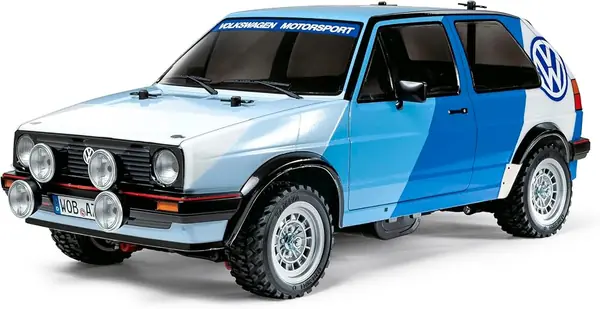
Tamiya ships this as a box of parts, and that's the appeal. Inside you get the polycarbonate Golf II GTI 16V body, the 540 motor, an electronic speed control, and an illustrated manual; you supply a radio with receiver, a steering servo, a 7.2V NiMH pack, and a charger. Price those four before you decide the kit is the cheaper route, because it usually isn't.

The chassis is why we picked this over Tamiya's other rally-bodied kits. MF-01X is a compact 4WD layout with a closed cardan-shaft drivetrain and independent suspension, wearing rally block tires, and the driveshaft runs inside the tub instead of hanging out where gravel can reach it. Finished, the car is about 397 mm long: small enough for a parking-lot course and detailed enough to sit on a shelf afterward.

What you're buying is the build. The 540 brushed motor will not keep up with the brushless cars here, and that's the honest trade for an afternoon with a screwdriver and a car that looks like the one that won Group A in 1986. We like that Tamiya keeps spares available for its kits long after release, so a snapped upright is an order rather than a reason to shelf the car.

Worth Noting

  • Requires radio, steering servo, battery, and charger
  • 540 brushed motor trails the brushless picks
Our Verdict

Buy this one for the build as much as the driving: a real MF-01X rally chassis and a Golf GTI body to finish yourself.

Check Latest Price
6.

RLAARLO 1/12 Brushless Rally Car Best for Experienced Drivers

RLAARLO 1/12 red-white brushless rally car with aluminum chassis and light kit

Experienced drivers

Track Score 84/100
Scale
1:12
Motor And ESC
3600KV brushless, 45A waterproof ESC
Chassis
2 mm 6061 aluminum
Radio
4-channel, 350 m range
View on Amazon

On paper this is the bargain of the group: a 45A waterproof speed control, a 3600KV motor on 3S, front and rear anti-roll bars, sealed differentials, a center slipper clutch, and a 2 mm 6061 chassis. The hardware is real. The trouble is that a short 1/12 car with this much power and no steering dual-rate adjustment on the radio is a handful, and that is the note we keep coming back to.

Run it hard on smooth pavement and it is genuinely quick, with the anti-roll bars keeping it flatter through a corner than the size suggests. Change direction fast, though, and it will trip over itself, because the short wheelbase and the speed are a difficult combination in anything less than a wide-open lot. This is not the car to hand a first-time driver at full throttle.

The radio is the part that decides who should buy it. Four channels and 350 meters of range are fine, but with no dual-rate adjustment you can't dial the steering back for a new driver or a tight course; you get the car's full appetite or nothing. The box does include 21 accessories, among them the hex drivers you will actually use. Buy it if you have smooth open pavement and some time in the hobby already, and point first-timers at the DIKAVEY in the same size.

Worth Noting

  • Parts can break in a hard hit
Our Verdict

Plenty of hardware for the money, but it asks for a smooth, open surface and a driver already comfortable at speed.

Check Latest Price

How We Tested the Best RC Rally Cars

We started with every 1/10, 1/12, and 1/14 rally car we could find, then filtered on the things that decide whether you can actually drive it: footprint, ground clearance, sealed electronics, a battery in the box, and whether the maker stocks replacement arms, gears, and driveshafts. Nine cars made it into the test — eight ready-to-run, plus one kit we assembled over a weekend on the workbench — and we ran them for six months.

Testing happened where these cars actually live. Sunday mornings in an empty school lot for speed runs and steering drills, weeknights on a rutted gravel service road, and a mowed field after rain to see what a damp surface did to the electronics. We taped each car's footprint and ride height, then drove the same line over a washboard patch to see which ones skipped and which stayed planted, and where a shock bottomed out.

After every dirt session we pulled the chassis apart and looked for grit in the drivetrain and around the ESC. Each car hit a curb at moderate speed to see what broke and whether the replacement part was cheap and in stock. Out on the lot we walked each car to the edge of its radio range and worked the gyro and steering dual rate at both ends of their adjustment.

We timed every charge on the included charger, counted how many packs a full afternoon took, and noted what each car did on a 2S pack versus a 3S. Packs were charged on a concrete floor, never unattended and never left in a hot car, and any pack that swelled was retired rather than run.

How to Choose an RC Rally Car

Match the Scale to Where You Drive

Most of what buyers get wrong starts here. A 1/10 rally car, and ours run about 16.4 to 17 inches long, needs a field, an empty lot, or a long stretch of fire road, and at 50 mph it covers that space fast. A 1/12 splits the difference, and a 1/14 like the Hyper Go turns a two-car driveway into a course.

Buy for the space you have rather than the space you hope to find. A fast car in a small yard is a car you drive at half throttle, which is a waste of the money you spent on brushless power.

Sealed Drivetrains and Metal Chassis Plates Survive Gravel

Gravel doesn't wear a rally car out from the outside; it gets into the drivetrain. Sealed differentials, a closed driveshaft tunnel, and a metal chassis plate are the three things that separate a car that lasts a season from one that lasts an afternoon.

Our 1/10 and 1/12 picks all list sealed diffs and aluminum chassis plates between 2 and 2.5 mm. When a maker mentions neither, assume the drivetrain is open and loose ground will find it.

What the Speed Claims Actually Mean

Nearly every fast car here quotes around 50 mph, and almost all of them need a 3S pack to get there. Check what ships in the box: the 1/10 and 1/12 picks include their 3S battery, while the 1/14 MJX does 42 km/h on the 2S pack it comes with and needs a 3S bought separately for more. Brushless motors paired with 35A-and-up speed controls are the hobby-grade baseline; anything less is a toy with a rally body bolted on.

We'd put a second battery ahead of a bigger one. Run time ends most sessions, not top speed.

Ride Height and Shocks Decide Whether It Stays Upright

A rally car needs clearance and compliance, not just grip. Oil-filled shocks and anti-roll bars let it absorb a rut and stay flat at speed, while a car set up low for parking-lot runs will catch its nose on a gravel crown. Raising ride height before your first off-road run is the cheapest handling upgrade available.

The other half is the radio. A gyro or a steering dual-rate adjustment keeps a short-wheelbase car from spinning, and the absence of the second is what makes some 1/12 cars a real handful in a small space.

Ready-to-Run or a Kit You Build

Ready-to-run remote control rally cars arrive with a battery, charger, and radio. The Tamiya kits arrive with a body, a motor, an ESC, and a manual, and you add a radio, steering servo, 7.2V pack, and charger, which means the kit is not the cheaper route once those are counted.

It isn't meant to be. The reward is the build itself and the parts support that comes with a model maker's catalog. Buy the kit if building is half the hobby; buy ready-to-run if you want to drive this weekend.

Frequently Asked Questions

Final Verdict

The RIAARIO 1/10 is the rally car we recommend for mixed-surface driving. Sealed differentials and a 2.5 mm aluminum chassis answer exactly what gravel punishes, and its 3S brushless power stays controllable at the top of the throttle rather than turning into a handful.

If your runs are long, smooth, and flat-out, the CROBOLL is the faster car and worth the extra money. If your space is a driveway rather than a field, the 1/14 Hyper Go makes far better use of it.