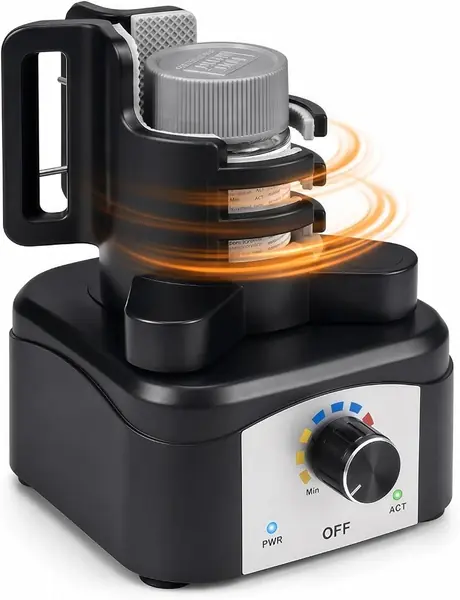
Best Model Paint Shakers of 2026

The ritual is familiar: cap a bottle of sepia, shake it against your palm for a solid minute, open it and find a clot of pigment still parked in the corner. A vortex shaker does that work for you, clamping the bottle and spinning it until pigment, medium and settled sludge come back together as one even color while you do something else.

Top speed is the least useful number on the box. A fast shaker that whips washes into foam is worse than a slower one with real low-speed control. What separates them is whether the clamp holds a slim 10 ml dropper bottle, whether the base stays put when the motor spins up and whether the noise drives you out of a small room.

Our Top Picks

The Best Model Paint Shakers

1.

Gaahleri Voortex Paint Shaker Best Overall
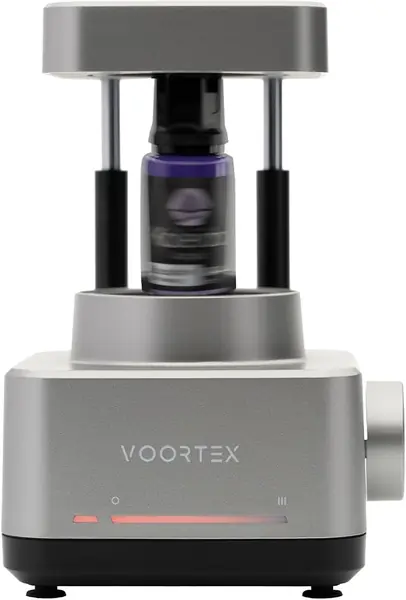
Gaahleri Voortex paint shaker with a clamp holder and an LED speed ring

Hands-free mixing

Track Score 88/100
Weight
2.71 lb
Max Speed
3,500 RPM
Bottle Range
25–50 mm (10–60 ml)
Speed Settings
3 speeds with digital timer
View on Amazon

What sold us is the timer. Set a sealed bottle into the stepped holder, pick one of the three speeds, and the Voortex runs the cycle while you keep painting — the LED ring tracks the run so nobody has to stand there counting. That is the whole difference between this and a touch-cup vortex mixer, where a thumb stays on the bottle for the entire shake.

The mixing is the strongest here both on paper and on the bench: a brushless motor turning to 3,500 RPM, the highest of the four, with enough force to bring pigment-heavy whites and metallics back to an even color instead of a streaky one. The three speeds give you somewhere to go for a wash you don't want aerated, and because the cycle is timed, a bottle spends only as long on the machine as you intended.

At 2.71 lb, sitting on a damped base with silicone isolation, it stays where you put it instead of creeping toward the bench edge mid-cycle. The holder takes bottles from 25 mm to 50 mm across, so a 17 ml dropper and a 2 oz craft pot both go in, and the stepped grip centers each one as you push down — swapping through a paint range doesn't turn into a fumble.

Worth Noting

  • Holder tops out at 60 ml bottles
Our Verdict

We recommend the Voortex to anyone who paints in batches: it holds the bottle, times the run, and mixes thick acrylics without creeping across the bench.

Check Latest Price
2.

LABHOUSE Vortex Paint Shaker Best for Large Bottles

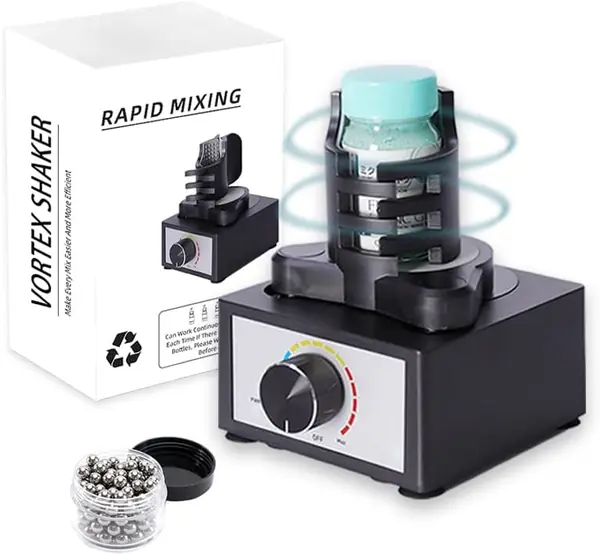
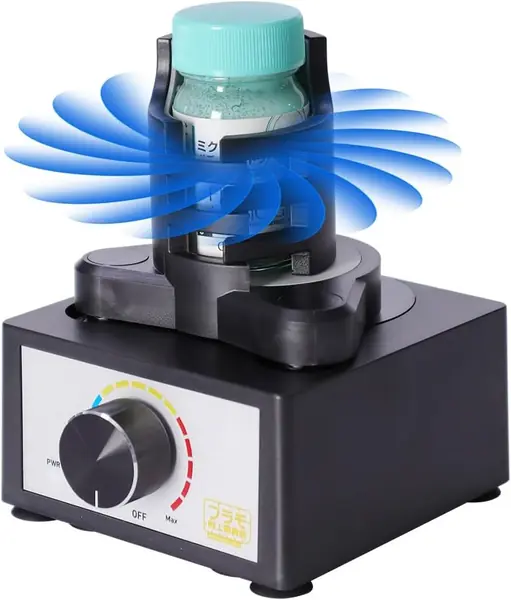
LABHOUSE black vortex paint shaker with an adjustable clamp and silicone suction feet

Large bottles

Track Score 86/100
Weight
1.32 lb
Footprint
6.02 x 4.21 x 3.7 inches
Max Speed
2,400 RPM
Bottle Capacity
Up to 100 ml
View on Amazon

Most holders on this list are built around dropper bottles. This one opens wide enough for a 100 ml jar or a 2 oz craft bottle, and if your paint drawer holds those bigger containers, it is the one to buy.

What we like beyond the capacity is the hardware: silicone suction cups that anchor it to a smooth bench, a brushless motor with three speeds, and a hundred stainless mixing balls in the box. Those balls are not a gimmick. Drop two into a thick, settled bottle and the shaker has something to work against, which is most of what a stubborn pot of base coat needs.

At 1.32 lb and a little over six inches deep, it lives on a shelf rather than owning a corner of the desk. It is also the priciest of the four, and a painter who only ever opens 17 ml droppers is paying for clamp width they never use — the Voortex mixes those bottles for less.

Worth Noting

  • Needs a rest after a few consecutive runs
Our Verdict

Buy the LABHOUSE when your shelf includes 2 oz craft bottles or 100 ml jars; the wide clamp and a hundred mixing balls make short work of containers the others cannot hold.

Check Latest Price
3.

BFFDIYCLUB Mini Vortex Mixer Best for Thin Paints

BFFDIYCLUB mini vortex paint shaker with an adjustable bottle clamp and speed knob

Washes and inks

Track Score 85/100
Weight
1.19 lb
Speed Range
300–2,400 RPM
Bottle Range
10–100 ml
Auto-stop
After 2 minutes
View on Amazon

Three hundred RPM is the slowest start of any shaker here, and that low end is why this one earns a place. Inks, washes and freshly thinned acrylics mix without folding a head of foam into the bottle; turn the knob and it climbs to 2,400 RPM for a pot that has been sitting since spring.

We also appreciate that the run stops itself after two minutes. You start a bottle, walk back to the model, and the machine is done whether or not you remembered it — a small thing that quickly becomes a habit. The clamp spans 10 to 100 ml, so the same unit covers your droppers and the larger craft bottles in the drawer below.

At 1.19 lb it is one of the lighter units here, which makes loading it properly worth the two seconds: seat a bottle square in the clamp before you dial up, because a tall bottle held off-center is where the grip gets tested. Set it up right and it behaves.

Worth Noting

  • Feet need a smooth, clean surface
Our Verdict

Our pick for thin paints: the 300 RPM floor and the two-minute auto-stop keep washes and inks from turning into a bottle of foam.

Check Latest Price
4.

HUBEST VM-01 Vortex Mixer Best for Crowded Benches

HUBEST VM-01 black vortex mixer with a weighted base and adjustable bottle clamp

Crowded benches

Track Score 76/100
Footprint
3.54 x 3.54 x 4.25 inches
Speed Range
500–3,200 RPM
Bottle Capacity
10–100 ml
Noise Rating
45 dB
View on Amazon

Five hundred to 3,200 RPM on a single knob is the widest spread of speed control in this group, and the housing is 3.54 inches square — the smallest footprint of the four. The motor is rated at 10 watts, which tells you most of what you need to know about how to use it: a bottle or two at a time, not a production line.

The base is weighted and ringed with suction feet, and HUBEST rates the motor at 45 dB, which would make it the quietest here. We treat a printed decibel figure as an opening claim rather than a measured promise, but there is nothing in the build that points to it being the loud one.

It is also the one we want more months with before calling it a default. For a small bench and a handful of colors in an evening, that reservation is easy to live with — the finest speed control here, in the least space, with a clamp that takes anything from a dropper to a 100 ml jar.

Worth Noting

  • Five to seven runs then a cooldown
Our Verdict

The one to choose when the bench is small: a full dial of speed in a 3.5-inch footprint, provided a handful of bottles per session is your workload.

Check Latest Price

How We Tested Model Paint Shakers

Every shaker on this list started as a candidate we found the way you would: reading spec sheets, then filtering for hands-free clamping, bottle range, low-speed control, and a footprint that wouldn't swallow a hobby desk. That narrowed the field to 10 machines spanning both formats and the full price spread, and we ran them for eight months on the same bench.

Most of that time was ordinary evening painting. We seated and clamped every bottle before starting, following each maker's instructions, then loaded 10, 17, 60, and 100 ml dropper bottles to see which clamps actually held the slim ones and which needed a shim. Timed runs happened while we worked on something else, and afterward we compared the bottle against a hand-shaken twin to check whether the pigment had fully lifted or was still sitting on the bottom.

To judge low-speed control, we ran thin washes and inks at the bottom of each range and watched for foam. Noise got measured with a meter at arm's length in a small room, then judged again from the next room. For stability, we noted whether a unit crept across the desk at full speed, how well the suction cups bit into a painted MDF top, and how much vibration traveled through the desk. We also ran back-to-back cycles within each maker's duty cycle, logging how warm the housing got and whether anything loosened or rattled after a few months. Price only counted at the end, weighed against all of it.

How to Choose a Model Paint Shaker

Hands-Free or Hand-Held

Two families of machine turn up under the same search results, and only one of them frees your hands. A clamp or holder unit grips a sealed bottle and runs on its own; a touch-cup vortex mixer needs steady downward pressure from your hand for the whole cycle, and it is usually rated for tubes up to about 50 ml. The prices overlap, so the product photos are where the difference hides — look for a strap or a clamp that closes over the top of the bottle. If you mix more than a bottle or two at a time, buy the clamp.

Match the Holder to Your Bottles

Holder range is the number that decides whether your paint drawer fits. Most clamp units open to about 50 mm, which takes 17 ml droppers and 2 oz craft pots but stops short of a 100 ml jar; go wider if you buy pigment or craft paint in bulk. Measure the widest bottle you own across the body, not the cap, and remember that a stepped grip centers round bottles far better than square or hexagonal ones.

One more thing worth knowing before you compare: the same 300 to 2,400 RPM clamp shaker is sold under several brand names with different badges and different prices. Compare holder size, clamp style and what comes in the box rather than the name on the front.

Speed, Timers, and Rest Periods

Top speed is the number on the box, but the low end is what you will actually use most. Thick, settled acrylics want the high range; inks, washes and anything freshly thinned want the slowest setting available, because a fast vortex whips air into thin paint. A timer or an auto-stop is worth paying a little more for, since the run ends without you standing over it. Take the rest period seriously as well — most of these motors ask for a pause after four to seven consecutive cycles, and a small motor run flat out all evening is the one that quits early.

Keeping It on the Bench

Weight and suction are what stop a shaker walking a bottle of paint off the edge. Silicone feet only hold on a smooth, non-porous surface, so a bare bench top or a glass mat works and a self-healing cutting mat does not; a thin silicone pad under a light unit fixes most wandering. Noise tends to climb with age, too — a bearing on its way out usually announces itself as a new rattle or a higher pitch before anything stops working, so treat a change in sound as the cue to rest the machine and check it over.

Frequently Asked Questions

Final Verdict

The Gaahleri Voortex is the shaker we point people to, and the timer is the reason: a bottle goes in, the run finishes on its own, and 3,500 RPM deals with the thickest paint in the drawer. It is also the least expensive of the clamp units here, which makes the recommendation an easy one.

Buy the LABHOUSE instead if your shelf runs to 100 ml jars and 2 oz craft bottles — its clamp opens wider than anything else in this group, and the hundred mixing balls in the box start you off.