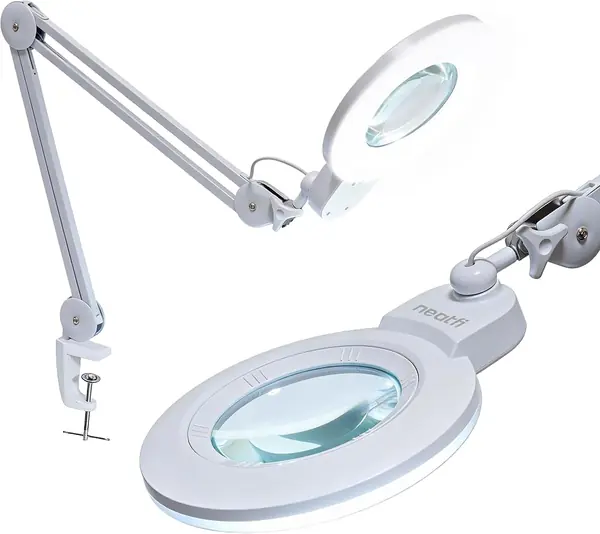
Best Magnifying Lamps for Electronics of 2026

Soldering by desk lamp and phone flashlight produces a familiar pose: shoulders around the ears, nose an inch from the board, one hand on the iron and the other holding everything else. A magnifying lamp fixes both halves at once, putting the work under glass and flooding it with light so both hands stay free for iron, tweezers and solder.

The magnification number tells you surprisingly little. Working distance decides whether an iron, a part and both hands fit under the lens, and a 30X view is useless without room to move. Stability comes next, since a lamp that dips when nudged has you refocusing more than soldering. The eight picks, from 12 used on soldering benches and craft tables, span clamped arms, weighted bases and lenses from small glass circles to a wide acrylic rectangle.

Our Top Picks

The Best Magnifying Lamps for Electronics

1.

Brightech LightView PRO Best Overall
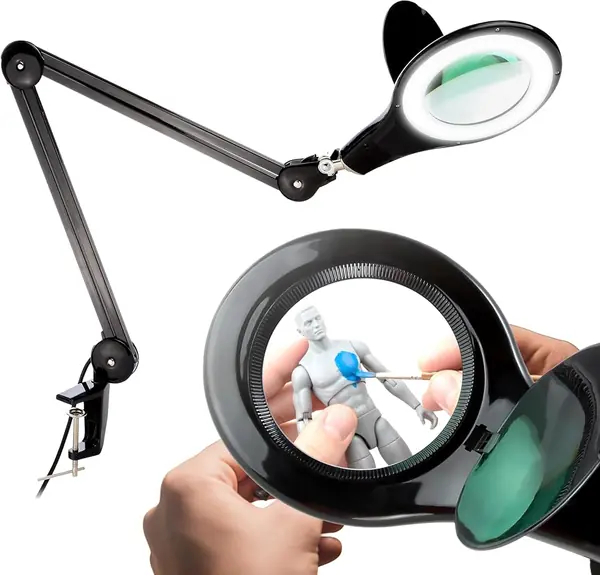
Brightech LightView PRO black clamp lamp with round glass magnifying head and swing arm

Soldering and repair

Track Score 93/100
Lens
Optical glass, focuses at 8 inches
Magnification
2.25X
Mount
Clamp with 21.5-inch swing arm
Light Source
56 LEDs, 9W
View on Amazon

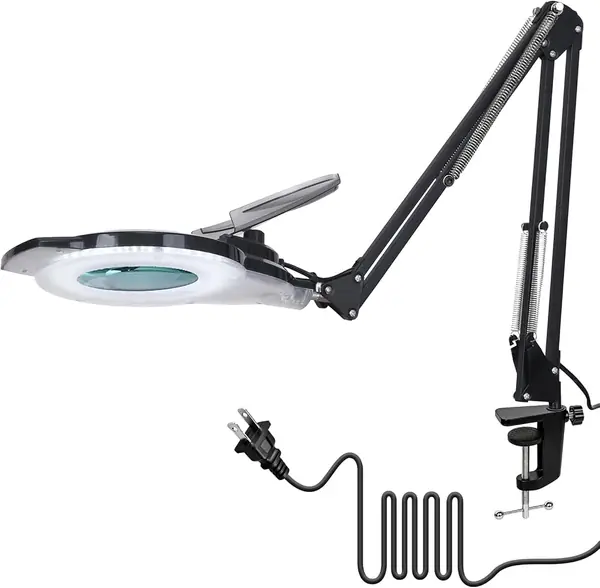
Eight inches is the number that makes this the lamp we keep on the electronics bench. That is where the 2.25X lens comes into focus, which is far enough to fit a soldering iron, a strip of wick, and both hands between your eye and the joint. The higher-power lamps in this group pull your face down to the work; this one lets you sit back and still see the pad clearly.

The rest of the hardware holds up its end. The 21.5-inch arm swings where you push it and stays there while you move a part around underneath, and the 56 LEDs spread an even pool of light instead of a hot spot in the middle of the board. Glass matters more than it sounds on a bench: it resists scratches and does not warp with heat, so the edge of a board stays as sharp as the center through months of use.

What we do not like is the mounting. The clamp is the only way to attach it, with no weighted base in the line, so the lamp needs a bench edge with overhang to grab and a bench pushed flush against a wall will not take it. The clamp holds firmly once it is on, but measure the lip of your tabletop before you order.

Because it hangs off the edge, it gives up no bench space at all, which is the quiet advantage over every stand lamp here. If your bench sits under a shelf, check that the arm can clear it through a full swing; folded down, the head tucks into a compact shape between sessions so you can get the cover back on the bench.

Worth Noting

  • Clamp only, with no weighted-base option
  • 2.25X will not resolve the smallest surface-mount parts
Our Verdict

We recommend it for any bench where soldering or wire work happens: 2.25X glass that focuses eight inches out leaves room for an iron and both hands.

Check Latest Price
2.

Neatfi Bifocal LED Magnifying Lamp Best for Fine Precision Work

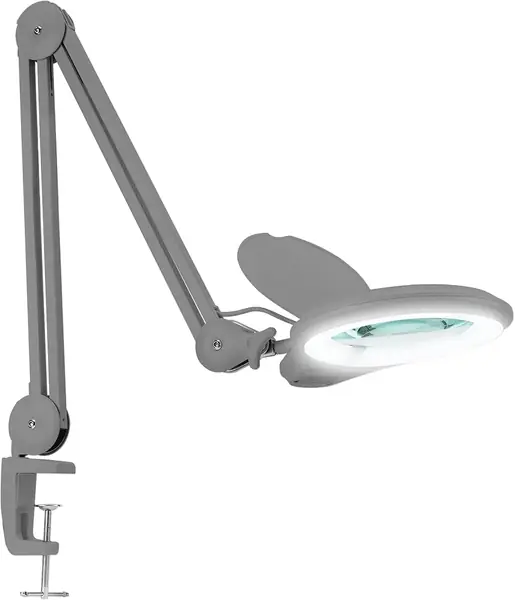
Neatfi silver clamp magnifying lamp with five-inch bifocal glass lens and long arm

Fine precision work

Track Score 92/100
Lens
5-inch glass, bifocal
Magnification
2.25X wide field, 6X inset
Light Output
1,200 lumens, dimmable
Clamp Capacity
Desks up to 2.7 inches
View on Amazon

Two powers in one piece of glass is the whole idea. The 5-inch lens carries 2.25X across its full width, and a smaller 6X inset sits in the middle for the moments when you need to read a marking or trace a bridge. Set the head at working height, look through the outer ring while you place a part, then move your eye to the inset to inspect it.

We like this arrangement more than we expected to. Switching powers with a small movement of your head beats swapping lamps mid-repair, and the 1,200 lumens behind the lens lights a board without washing out the sheen on a solder joint. The clamp bites hard on a bench edge and opens to 2.7 inches, and the 36-inch arm covers a deep top without the base of the lamp ever entering your work area.

Two things to know. It costs meaningfully more than our top pick, and you are paying for the second lens and a three-year warranty rather than for extra light. Also, if your bench doubles as a radio setup, the LED driver can throw RFI, so keep a receiver a few feet away or on a different circuit.

The arm holds a set position nicely when it works down over the bench, but pushed out horizontally at full stretch it can drift, so keep the clamp close to the job and fold the arm rather than reaching. A microfiber cloth comes in the box, which sounds trivial until the first bit of flux lands on the glass.

Worth Noting

  • Arm can drift when stretched out horizontally
Our Verdict

If your work runs from wire repairs down to single components, this is our pick: a 5-inch glass lens with a 2.25X field and a 6X spot in the middle.

Check Latest Price
3.

HITTI 10X Magnifying Lamp Best Two-In-One Mount

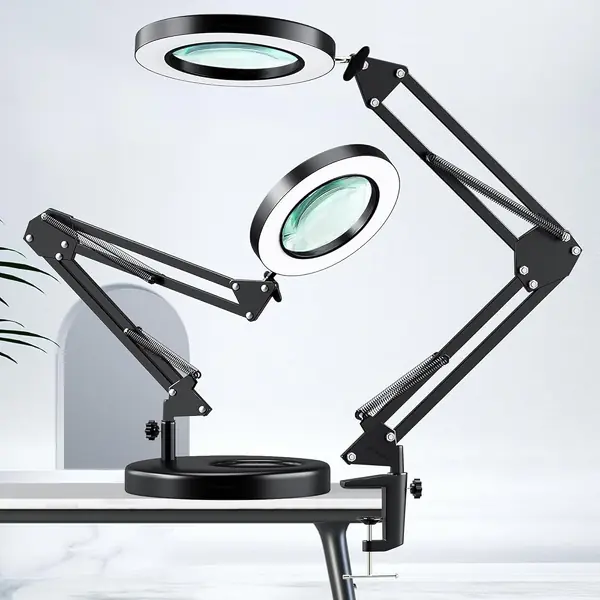
HITTI black magnifying desk lamp with large weighted base and metal clamp

Shared workbenches

Track Score 91/100
Lens
4.2-inch real glass
Magnification
10X
Light Output
1,800 lumens, dimmable 10-100%
Mounts
9-inch weighted base and metal clamp
View on Amazon

Not every bench has an edge you can clamp to, and that is the gap this lamp fills. The base is the widest here at just over nine inches, and it is heavy enough that the arm can hang out over a board without the whole thing tipping. That is the job a clamp would otherwise do, done with mass instead.

The 4.2-inch real glass lens is 10X, a different tool from the 2.25X lamps above. You use it for reading part numbers and inspecting joints, and you will have your eye close to the head while you do it. Light output is 1,800 lumens with three color modes and dimming from 10 to 100 percent, and the ring layout keeps shadows off the board rather than throwing them from one side.

Ten power is the trade: the head sits close to the work, so you lean in for inspection and pull back for placement. With this much light on tap, dial it down — full power on a glossy board or a tinned plane bounces straight back at your eyes. Between the two mounts, the base is the one that makes this lamp unusual; plenty of lamps clamp, and few stand this steadily.

Worth Noting

  • Clamp is the weaker of the two mounts
  • Large base needs a dedicated bench spot
Our Verdict

We keep this one for benches that cannot be clamped: a nine-inch weighted base heavy enough to hold the arm out, plus a metal clamp for the days an edge is free.

Check Latest Price
4.

RackydigPro 12X Magnifying Lamp Best Value

RackydigPro black gooseneck magnifying lamp with clamp and round glass lens

Clamped bench work

Track Score 90/100
Lens
3.75-inch real glass
Magnification
12X
Light Output
Up to 1,500 lumens, 5 color modes
Mounts
Clamp, plus a stand base
View on Amazon

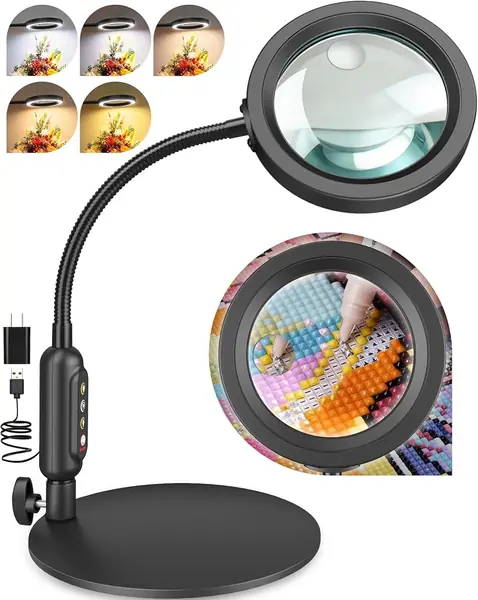
The gooseneck is where the money went. It is a 360-degree metal neck, and the control button sits on the neck rather than on a cord switch, so you can change brightness or color without taking your eye off the board. Clamped to a bench edge, the head goes exactly where you push it and stays there while you work underneath.

We think this is the best value in the group for a clamped bench. Twelve power is more than you need for through-hole work — it is for reading markings, spotting bridges, and checking a row of pins — and the 3.75-inch real glass lens keeps a clean image right out to the rim. Five color modes with stepless dimming mean you can drop the glare coming off a bare copper plane without losing detail.

Where it gives ground is the stand. Set on its own base instead of clamped, it tips when the neck is stretched out, and 12X pulls your eye close to the head in any case, so the two problems arrive together. Bolted to a bench edge both disappear, which is how we would run it on a soldering bench.

Worth Noting

  • Base tips when the neck is fully extended
Our Verdict

Our value pick: 12X glass on a clamped gooseneck with five color modes and 1,500 lumens, at the bottom of the price range here.

Check Latest Price
5.

RunSenFo 10X/30X Magnifying Lamp Best Stand Lamp

RunSenFo black stand magnifier with round glass lens and metal base tray

Compact desks

Track Score 89/100
Lens
4.3-inch optical glass
Magnification
10X main, 30X inset
Light
5 color modes, stepless dimming
Mount
Weighted metal base
View on Amazon

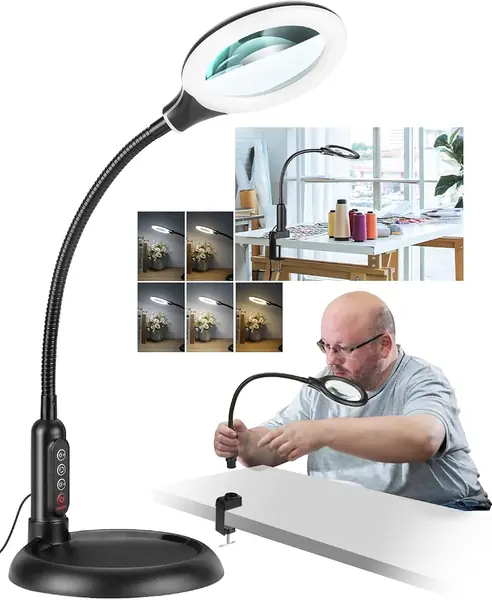
There is no clamp on this one. It is a base lamp at 2.2 pounds, with a 16-inch metal gooseneck and a circular base wide enough to hold a few screws while you work. The neck is stiff rather than floppy, which is what you want here: it takes a deliberate push to move the head, and then it stays where you left it.

The lens is 4.3 inches of optical glass with a 10X main field and a 30X inset. We worked almost entirely through the main lens; the inset is small, and getting anything useful out of it takes good light and a very steady head. Light comes from five color modes with stepless dimming on the neck, and even at a dim desk you will not need full power.

This is the one we set down on a compact desk where a clamp had nothing to bite and a heavier base would have been too much furniture. The weighted base stays flat when you push the neck out over the work, and the tray catches the small parts that would otherwise roll onto the floor. Against the clamp lamps it is less flexible about odd angles, but for a desk that has to go back to being a desk, it lifts off in one piece.

Worth Noting

  • 30X inset is too small to work through
  • No clamp option for an edge mount
Our Verdict

Our stand pick for a compact desk: a lightweight metal base that doubles as a parts tray, a stiff neck, and 10X glass that holds its position.

Check Latest Price
6.

KIRKAS LED Magnifying Lamp Best for Deep Benches

KIRKAS black clamp magnifying lamp with long swing arm and lens dust cover

Deep benches

Track Score 88/100
Lens
4-inch optical glass
Magnification
12X
Light Output
2,200 lumens, 6,000K, dimmable
Arm
28-inch reach with clamp
View on Amazon

Twenty-eight inches of arm and 2,200 lumens make this the longest-reaching and brightest lamp here. The head carries a rotary dimmer on top, where you can reach it without hunting along a cord, and a cover that keeps dust and flux spatter off the 4-inch glass between sessions.

The joints are tensioned with a screw you can snug when the arm starts to droop, and the head tilts to throw light across a board rather than straight down into your eyes. Twelve power is for inspection rather than placement: you will be leaning in close for the fine work.

We rate the light and the reach highly and the clamp less so. It is a small clamp, so a thick bench top with no thin overhang gives it nothing to hold, and the joint just above the clamp is where play shows up first. On a thin, permanent bench edge it is a lot of light for the money; if the lamp moves between tables, look at the RackydigPro instead.

Worth Noting

  • Cool-white light only, with no warm modes
Our Verdict

We like the reach and the 2,200 lumens; the clamp is the weak link, so buy it for a bench where the arm can stay put.

Check Latest Price
7.

Drdefi 12X Square Magnifying Lamp Best for Reading Part Markings

Drdefi black magnifying lamp with rectangular glass lens, base, and clamp

Reading part markings

Track Score 87/100
Lens
Rectangular real glass
Magnification
12X
Mounts
Weighted base and clamp to 2.1 inches
Light
5 color modes, stepless dimming
View on Amazon

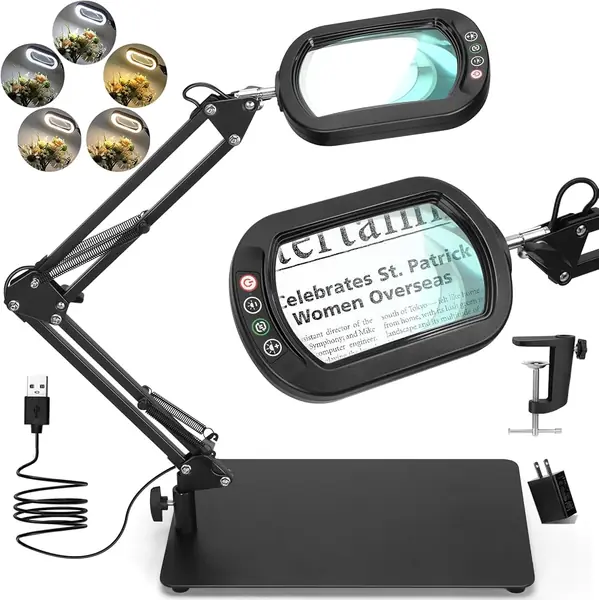
A square lens changes how you work. Instead of a circular patch of magnification with the corners falling away, you get a rectangle that matches the shape of an IC row or a line of header pins, so you can scan along a component without re-aiming the head for every pin.

Twelve power, five color modes, stepless dimming, and a head button: the controls follow the same formula as most of the lamps here, and they work. The base is a flat weighted plate that does not slide, and the clamp, for tops up to 2.1 inches, lets you take the same head to a bench when you need to.

The arm is where it comes up short. There is a limited pivot when the lamp sits on its base, narrower than the swing-arm lamps here, so you may find yourself shuffling the whole base to get light where you want it rather than tilting the head.

We settled on this as the lamp for reading markings rather than for soldering. Set it over a board at 12X and the rectangle genuinely beats a round lens for working along a row; set it over a joint and you are leaning in more than you want to be. If inspection happens at your bench and the iron work happens under a wider lens, this makes a good second lamp.

Worth Noting

  • Limited pivot when it sits on its base
Our Verdict

We like the rectangular lens most: it frames a row of pins the way your eye reads it, and the base means it can move from bench to table.

Check Latest Price
8.

Neatfi 7-Inch LED Magnifying Lamp

Neatfi white clamp magnifying lamp with large seven-inch lens and dimmable LEDs

Wide board inspection

Track Score 86/100
Lens
7-inch acrylic
Magnification
2.25X field, 6X inset
Light Output
1,600 lumens, 4 levels
Arm
36-inch, 360-degree rotation
View on Amazon

Seven inches of lens is not a small upgrade. At that size you look through the glass with both eyes, which restores depth perception — you can judge how far a probe tip sits above a pad — and the field covers a whole board section instead of one joint.

The lens is acrylic rather than glass, so it scratches and hazes more readily than the glass lenses on the other picks here; keep the cover on and wipe it with the cloth rather than a shop rag. It is a dual-power lens, 2.25X across the field with a 6X inset, and 84 LEDs push 1,600 lumens through four dimming levels.

The 36-inch arm rotates a full turn at the base and locks where you leave it. It takes some muscle to reposition when it is mounted high — there is a stiffness in the joints that is reassuring over a bench and tiresome when you are reaching up to move the head.

We recommend it for one job: inspecting wide work where both eyes matter, such as a populated board, a connector shell, or a run of solder mask. For a single joint the extra lens just means more glass to keep clean, and it is the most expensive lamp in this guide. The 2.25X field does the everyday work; the 6X inset earns its place on fine pitch.

Worth Noting

  • Acrylic lens scratches more easily than glass
  • Highest price in this group
Our Verdict

For the widest view you can get without a visor, we point to this: a seven-inch lens big enough for both eyes, backed by 1,600 lumens.

Check Latest Price

How We Tested Magnifying Lamps for Electronics Work

We started with lamps sold for close work and read the specs that change a buying decision: lens material, clamp capacity, arm reach, magnification, and whether the mount is a clamp, a weighted base, or both. Lamps whose makers never named a lens material or a magnification didn't move forward. From there we tested 12 lamps across the price range, from short clamped models to long-reach arms, on real benches for seven months.

Most testing happened where these lamps live: a soldering bench and a craft table. We clamped each clamp model to bench edges of different thicknesses and shook the bench to see if the grip slipped, and set the base models at full extension on a smooth desk and nudged them to check for tipping. For working distance, we laid a scrap board under the lens and slid an iron and tweezers in to see how much room the view left. We read the smallest part markings we had and clipped component leads with safety glasses on.

Brightness was judged with work in place: we dimmed each lamp to its lowest setting over a glossy board and looked for a hot spot, then ran the color modes to see which helped tell a resistor from a capacitor. Arms were pushed to full extension and left for an afternoon to see if a head drooped, and we noted how often joints needed re-tightening and how much bench the lamp claimed once parked. Lenses got wiped with a microfiber cloth after each session, once the head had cooled.

We read warranty terms before ranking anything, and weighed what each lamp cost against its mount, lens, and light. Value wasn't the lowest price — it was how much of the work the lamp took over.

How to Choose a Magnifying Lamp for Electronics

Start With Working Distance, Not Magnification

The magnification figure on the box tells you less than the distance at which the lens focuses. A 2.25X lens like the Brightech's comes to focus about eight inches from the work, which is roughly the room an iron, a hand, and a pair of tweezers need. A 10X or 12X lens pulls that distance down to a couple of inches, so your knuckles end up between your eye and the joint.

The most common mistake is assuming more power means a better bench lamp. For through-hole soldering, wire repairs, and connector work, stay between 2.25X and 5X; add a 10X lamp or a bifocal inset for reading markings and checking for bridges.

Match the Lens Size and Shape to the Work

Lens diameter decides how much board you see at once, and shape decides how well that patch matches the job. Round lenses from about 3.75 to 5 inches cover a joint or a component; the seven-inch Neatfi lens is wide enough to look through with both eyes, which restores depth perception. Rectangular lenses, like the Drdefi's, frame a row of pins more naturally than a circle does.

Material is the other half of the choice. Real glass resists scratches and stays clear; acrylic is lighter and cheaper but hazes as it ages. And diopter and X describe the same scale — 5 diopter is 2.25X, 20 diopter is 6X — so a box that mixes them is not offering two features.

Decide Between a Clamp and a Base

Clamp or base is usually settled by your furniture rather than your taste. A clamp frees the entire bench surface and holds the head steadier, but the jaws here top out between roughly 2.1 and 2.7 inches, so measure the overhang of your top before ordering. A bench pushed flush to a wall, or one with a thick apron, will not take one.

A weighted base needs eight or nine inches of clear surface and can tip when the arm is stretched out. Two-in-one lamps such as the HITTI and the Drdefi give you both mounts, which is worth the extra bulk if the lamp has to travel between rooms.

Look Past the Lumen Count

Output figures here run from about 1,200 to 2,200 lumens, and it is tempting to read that as a ranking. It is not one: you are lighting a square foot of bench, not a room, and a 1,500-lumen head at half power usually beats a brighter one at full, because glare off a glossy board or a tinned joint washes out exactly the detail you bought the lens for.

What we look for instead is a real dimming range — down to around 10 percent — and one warm or neutral setting for long sessions under cool white light. A control on the head means you can adjust without reaching for a cord switch.

Plan the Arm and Where the Head Parks

Reach is measured along the arm, not from your bench edge to your work, so lay out the bench before you commit. A 21- to 28-inch arm lets the clamp sit at a back corner and still put glass over the middle of the top; a long gooseneck needs a firm clamp or a heavy base behind it or the whole lamp leans.

Think about where the head goes between jobs, too. A lamp that folds down over its own base takes far less room than one that has to be swung off to the side, and if there is a shelf above your bench, check the height before you buy the tallest option.

Frequently Asked Questions

Final Verdict

Start with the Brightech LightView PRO. Its 2.25X glass focuses far enough out that an iron, tweezers, and both hands fit between your eye and the joint, and the clamp costs you no bench space — which is what most soldering benches are shortest on.

If the smallest parts are your daily work, the Neatfi bifocal adds a 6X spot over the same bench. If there is no edge to clamp to, the HITTI's nine-inch weighted base does the job a clamp would.