Best FPV Drone Batteries of 2026

Props and tune matter less to an FPV flight than the pack strapped to the top. Capacity buys air time and adds weight, and a heavy quad handles like a brick; cut the weight and you get three lively minutes before the voltage sags. Then there's the connector, which either fits your ESC lead or leaves the pack on the bench.

The C-rating on the label is closer to a wish than a measurement. What you feel in the air is voltage sag on the first hard punch, and a cheap pack that can't hold voltage cuts flights short. We flew 14 packs, from 300mAh micros to a 6S freestyle brick, and the seven here cover freestyle, long-range, micro and HV toothpick builds, each one balancing cleanly charge after charge.

Our Top Picks

The Best FPV Drone Batteries

1.

OVONIC 6S 100C 1300mAh Best Overall
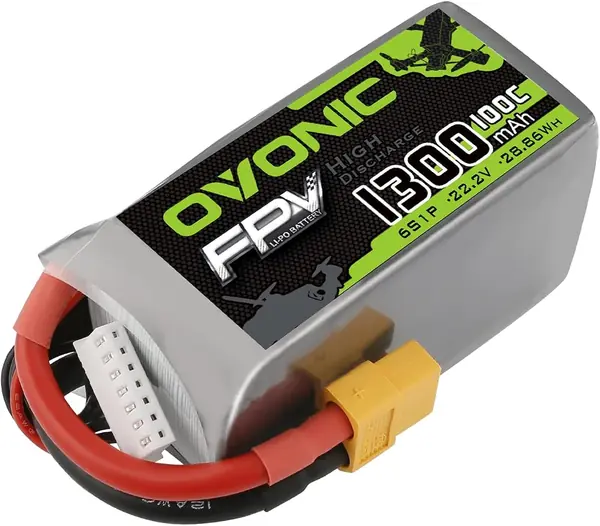
OVONIC 6S 1300mAh LiPo battery with XT60 connector and balance lead

5-inch 6S freestyle

Track Score 93/100
Capacity
1300mAh
Connector
XT60
Cell Count
6S (22.2V)
Discharge Rate
100C
View on Amazon

Six cells, 1,300 milliamp-hours, XT60 plug: that combination is what a modern 5-inch freestyle quad is built around, and the OVONIC is the pack we point most people to first. The 22.2 volts suit a 6S motor and ESC combination, and 1,300mAh is the freestyle sweet spot — enough for a five-minute run of mixed throttle without hanging a brick on the frame.

What sold us is the discharge rating against the price. A 100C label on a 1,300mAh pack works out to a claimed 130 amps, comfortably past what a 5-inch quad will ask for, and that headroom shows up as punch at the top of the throttle range rather than a pack that goes soft in the second half of a run. The XT60 and the balance lead both came properly seated, which sounds like a low bar until you have re-soldered a plug on a brand-new battery.

At 225g it sits on the heavy side for the class, which you notice on a light 5-inch build and forget on a heavier freestyle rig. The thing to watch is cell life: a pack that stops taking a balance charge after a handful of outings is the failure mode in this price bracket, so check individual cell voltages after your first few cycles while a return is still easy.

Worth Noting

  • Discharge leads run short on tight builds
Our Verdict

For a 5-inch freestyle quad, this is the pack to start with: the right 6S voltage, a real XT60 plug, and 100C of headroom at a budget price.

Check Latest Price
2.

Zeee 4S 3300mAh 50C (2-Pack) Best for Long Flight Times

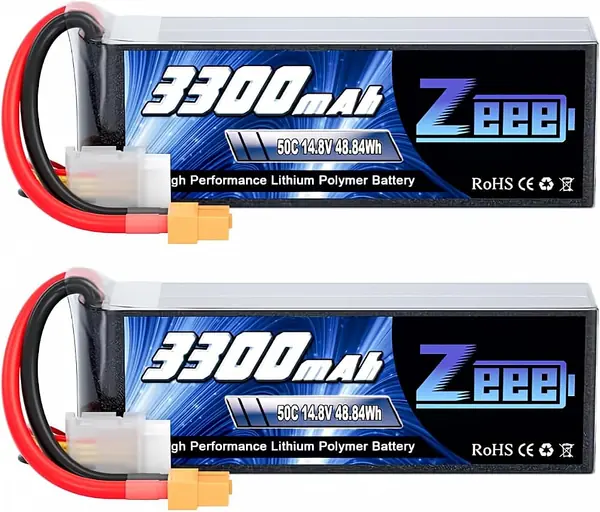
Zeee 4S 3300mAh LiPo battery pair with XT60 plugs and soft cases

Long-range 4S builds

Track Score 92/100
Capacity
3300mAh
Connector
XT60
Cell Count
4S (14.8V)
Weight
348g / 12.28 oz
View on Amazon

At 348g, the Zeee 4S 3300 is the heavyweight of the group, and that weight is the whole argument: 3,300 milliamp-hours at 14.8 volts buys flight time nothing else here can match. We like it on builds that are not trying to be light — a 7-inch cruiser, a 4S long-range rig, a 70mm EDF, or a big trainer that wants nose weight anyway.

The 50C rating works out to a claimed 165 amps, plenty for a 4S 5-inch or a larger plane, and both packs arrived with their cells closely matched on our charger, which is the first thing we check on a budget pack. The soft case is standard fare; the XT60 plugs are proper XT60s, not the loose copies that arc under load.

Where it does not suit you: a light 5-inch 4S quad, where the extra mass is ballast you feel in every direction change. Treat it as a long-flight pack and it earns its place — cruising, a wing, or keeping goggles and a ground station alive all afternoon.

Worth Noting

  • 131mm body is long for some 5-inch bays
Our Verdict

If flight time matters more than weight, this is the pair we recommend — 3,300mAh of 4S capacity for cruisers, wings, and ground-station duty.

Check Latest Price
3.

Zeee 3S 120C 1300mAh Graphene (2-Pack) Best Budget Racing Pack

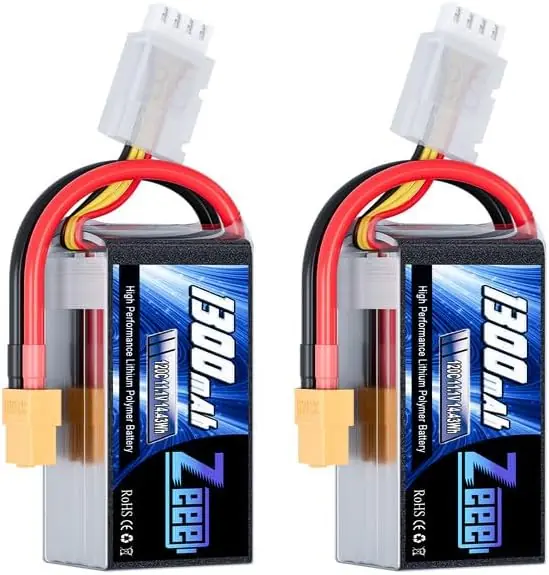
Zeee 3S 1300mAh graphene LiPo battery pair with XT60 connectors

Small 3S quads

Track Score 91/100
Capacity
1300mAh
Connector
XT60
Cell Count
3S (11.1V)
Discharge Rate
120C
View on Amazon

Two graphene 3S packs with XT60 plugs and a 120C label for less than a single premium battery — if you are building a rotation to practice on rather than buying one good pack, that math is the reason to look here. 1,300mAh at 11.1 volts is the classic 3S racing size, and at 122g the packs are light enough for a 3-inch or 4-inch build and fine on a 3S 5-inch trainer.

The 120C figure is the headline, and on 1,300mAh it means a claimed 156 amps, far more than a small quad pulls — which is the point, since the pack should not be what limits a punch-out. The graphene language is mostly marketing as far as we can tell; what matters at this price is the hardware, and the XT60 plug and balance lead are both properly done here.

Where we land: buy these in pairs when you would rather have four batteries than two, and put the difference toward a better charger. Keep them on 3-inch and 3S trainer duty — a 5-inch on 3S wants more milliamp-hours than this, and the smaller quads are where a light 120C pack actually feels quick.

Worth Noting

  • A weak cell can show up within the first few charges
Our Verdict

Our budget pick for 3S racing: two 120C packs with real XT60 plugs for less than a single premium battery.

Check Latest Price
4.

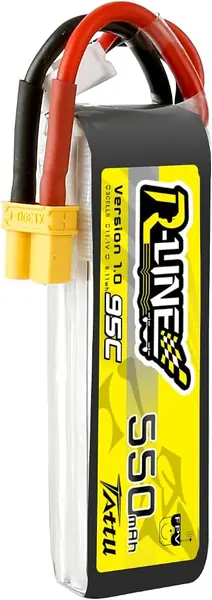
Tattu R-Line 3S 550mAh Best for Micro Quads

Tattu R-Line 3S 550mAh LiPo battery with XT30 connector

Micro FPV quads

Track Score 90/100
Capacity
550mAh
Connector
XT30
Cell Count
3S (11.1V)
Discharge Rate
95C
View on Amazon

At 46g and 69mm long, the Tattu R-Line 550 disappears inside a 3-inch frame. It is sized for the 100-to-180mm multirotor class, and the XT30 plug says the same thing the weight does: this is a micro pack, not a scaled-down 5-inch battery.

We keep coming back to Tattu for small quads because the R-Line cells hold their voltage through a full-throttle burst instead of sagging halfway through it. The 95C rating on 550mAh works out to a claimed 52 amps, more than a 3-inch build's motors will draw, so the pack is rarely the limit on a small, high-KV setup.

Flight time is the catch. 550mAh on a 3-inch build is a couple of minutes of hard flying, so this is a pack you buy three or four at a time and treat as a set; the upside is that they charge quickly off a single charger between rounds. If your quad is bigger than 3-inch, this is the wrong end of the range.

Worth Noting

  • XT30 only, so XT60 quads need a rewire
Our Verdict

The micro pack we reach for: 46g, XT30, and 95C of R-Line punch for 100-180mm quads that count every gram.

Check Latest Price
5.

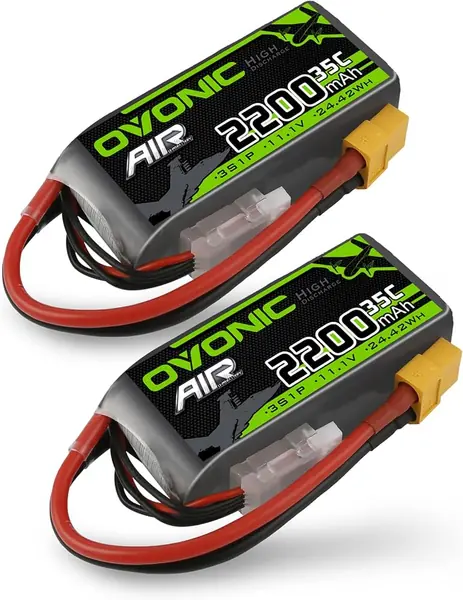
OVONIC 3S 2200mAh 35C (2-Pack) Best for Cruisers and Trainers

OVONIC 3S 2200mAh LiPo batteries, two soft-case packs with XT60 plugs

Cruisers and trainers

Track Score 89/100
Capacity
2200mAh
Connector
XT60
Cell Count
3S (11.1V)
Discharge Rate
35C (70C burst)
View on Amazon

A 3S 2,200 is the pack that ends up in everything: a 5-inch cruiser on a lazy afternoon, a 450-size helicopter, a trainer plane, a crawler with an XT60 lead soldered on. This OVONIC pair covers that spread for less than a single 6S race pack, and the 75 x 33 x 25mm case slides into bays a longer 2,200 will not.

The 35C rating is modest next to the 100C-and-up packs here, but do the arithmetic: 2,200mAh at 35C is a claimed 77 amps continuous, 154 on burst, which is more than a 3S 5-inch build or any trainer will ask for. At 139g the pack is light for its capacity, and that is the other reason it turns up in so many different airframes.

One thing we noted while cycling the pair: watch the storage voltage. A pack that self-discharges overnight and will not hold a storage charge is the pattern to check for, so measure the cells a week after putting them away before you trust one to a long flight.

Think of it as the utility pack in the drawer. It will not win a race against a 120C graphene brick, but for a cruiser, a trainer, or a borrowed airframe, two 2,200s for the money is the easiest spare-battery decision here.

Our Verdict

The do-everything 3S two-pack: long run times for cruisers, trainers, and crawlers, at a price that makes keeping spares easy.

Check Latest Price
6.

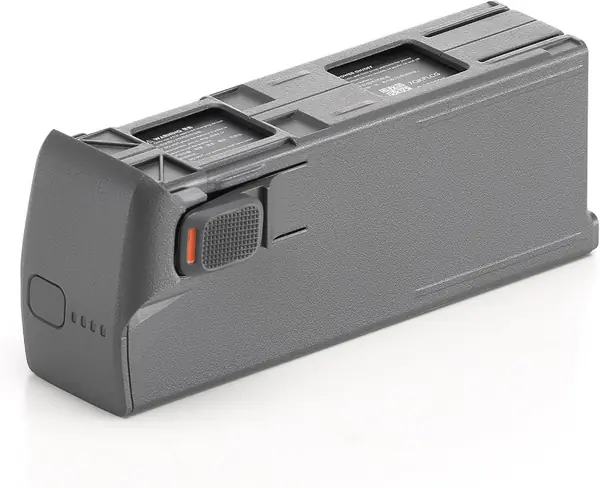
DJI Avata 2 Intelligent Flight Battery Best for Avata 2 Pilots

DJI Avata 2 Intelligent Flight Battery pack with integrated connector

Avata 2 pilots

Track Score 88/100
Capacity
2150mAh
Voltage
14.76V
Compatibility
DJI Avata 2 only
Rated Flight Time
Approx. 23 min
View on Amazon

There is exactly one aircraft this pack fits, and DJI made sure of it: no XT60, no adapter, no second life in a homebuilt quad. If you fly an Avata 2, that is fine — this is the pack we trust most in the whole group, and it is the only one here whose flight time is quoted against a specific airframe.

The numbers are straightforward: 2,150mAh at 14.76 volts, with a rated 23 minutes measured flying forward at 21.6 kph in a windless environment at sea level, camera set to 1080p/30fps with video mode off. Those are DJI's own test conditions, and a real flight with the camera rolling and wind in the props comes in shorter.

What you are paying for is fit and certainty — the pack seats and locks, there is no soldering, no connector swap, and no guessing about C-rating. A pack that only charges to partial capacity or drains faster than it should is the thing to catch early, so run a few full cycles while the return window is open.

Worth Noting

  • Premium price for a single pack
Our Verdict

If you fly an Avata 2, this is the safest buy on the page — rated 23-minute flights, a guaranteed fit, and no adapter in sight.

Check Latest Price
7.

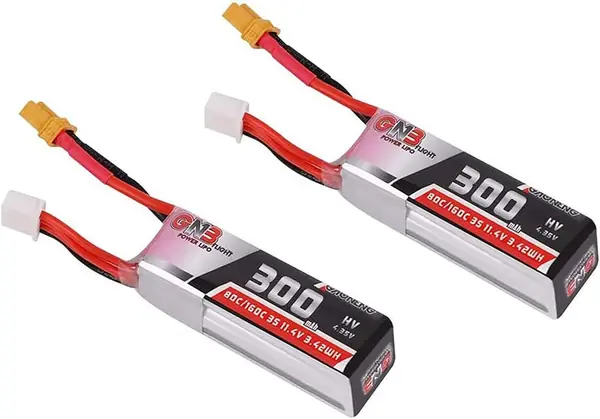
GAONENG 300mAh HV 3S (2-Pack) Best for HV Toothpick Quads

GAONENG 300mAh HV 3S LiPo battery pair with XT30 connectors

HV toothpick quads

Track Score 85/100
Capacity
300mAh
Connector
XT30
Cell Count
3S HV (11.4V)
Discharge Rate
80C (160C burst)
View on Amazon

11.4 volts instead of 11.1 — an extra tenth of a volt per cell is what HV means, and it is the whole reason this 300mAh pack exists. The GAONENG is built for the BetaFPV 75X and the HD toothpick class, where 29g and a 53mm case are the difference between a quad that flies and one that sits over the weight line.

The 80C continuous, 160C burst rating is high for a pack this size, and it comes with 18AWG silicone wire and an XT30 plug — the right hardware for a sub-250g build. We were struck by how much current these little cells give when you ask for it; on a 2-to-3-inch toothpick the motors, not the pack, are what hold you back.

Here is where we land: this is a specialist's pack. Per milliamp-hour it is the most expensive route in this group, and a quad built around standard 4.2V cells gains nothing from it. If your frame was designed for HV cells and an XT30, though, nothing else here fits the same slot.

One hard requirement. Your charger needs an HV mode that tops out at 4.35 volts per cell; charging these on a standard 4.2V LiPo profile leaves capacity unused, and putting a standard LiPo on the HV profile is how packs catch fire. Get that setting right and the rest is routine.

Worth Noting

  • Cell life can run short in hard-flown builds
Our Verdict

For HV toothpick builds like the BetaFPV 75X, this is the pack that fits — 29g, XT30, and 11.4 volts of extra punch.

Check Latest Price

How We Tested FPV Drone Batteries

We built the shortlist from spec sheets rather than reviews, ranking cell count and voltage first, then connector type, then capacity against listed weight and dimensions — the things that decide whether a pack fits an airframe at all. Over six months we bought 14 packs at retail, from a 300mAh 3S HV micro pack up to a 6S 1300mAh freestyle pack, and flew each in the airframe it was sold for.

On the bench, every pack went on a LiPo balance charger at or below its rated rate, on a concrete floor, with someone in the room the whole time. We logged each cell's voltage out of the box, after every charge, and after every flight, stored packs near 3.8V per cell between sessions, and weighed each one on a kitchen scale and checked it with calipers against the battery bay it was headed for. HV packs only ever went on the charger's HV setting.

In the air we only flew packs whose cell count matched what the quad's ESC and motors were rated for. Each got the same routine — a hover, a run of full-throttle punch-outs, and a climb to the low-voltage warning — while we watched how far voltage sagged on the first punch and how fast the cells came back. Across the first several cycles we tracked balance drift, felt for puffing or soft corners, and timed every charge.

Since most of these ship in pairs, we also logged what each pack cost per unit and set that against how many cycles it held its voltage through.

How to Choose FPV Drone Batteries

Start With Cell Count and Voltage

A 5-inch freestyle quad on 6S wants 22.2-volt packs around 1,300mAh, with motors roughly in the 1,700 to 1,800KV range. The same airframe on 4S wants 14.8 volts, a little more capacity, and higher-KV motors. Three-inch and 4-inch builds live on 3S, and micros use 3S or 2S packs from 300 to 550mAh. The trap is treating cell count as an upgrade: a 6S pack on an ESC and motor set rated for 4S will destroy them. Check the ESC's voltage rating first and the motor KV second.

The Connector Decides Whether It Flies

Nearly every 5-inch quad runs XT60, micros and toothpicks run XT30, and older gear and some cars still use Deans T or JST. Adapters work in a pinch, but each one adds a resistance point and a joint that has to carry a hundred amps without getting hot; we prefer to buy the right plug or re-solder the lead. Check both ends before ordering, because a field bag full of packs with the wrong plug is the most common way this purchase goes wrong.

Capacity, Weight, and Real Flight Time

Capacity buys time and costs grams, and the trade is steeper than the milliamp-hour numbers suggest. A 1,300mAh 6S pack runs around 225g; a 3,300mAh 4S pack runs near 348g. On a light 5-inch you feel that difference in every direction change, and on a micro it decides whether you fly or sit on the ground. Match capacity to the airframe rather than to ambition: 1,300 to 1,500mAh for 5-inch freestyle, 550 to 850 for 3-inch, 300 to 450 for whoops, and 2,200 to 3,300 only when a wing or a long cruise is carrying it.

What the C-Rating Really Tells You

Multiply the C-rating by capacity and you get the manufacturer's claimed continuous current: 1,300mAh at 100C is 130 amps, 2,200mAh at 35C is 77. Most 5-inch builds pull well under the biggest numbers on the shelf, so a 120C wrapper does not buy much over a 95C one, and no shared standard governs how those labels are measured. What you feel in the air is voltage sag under throttle — a pack that holds its voltage under load feels punchier than one that dips, whatever the label says. Buy on cell quality and weight, not the biggest number.

Don't Mix Old and New Packs

If you parallel charge at the field or run two packs in a wing, they need the same cell count, the same capacity, and roughly the same age and internal resistance. A tired pack paired with a fresh one drags the pair down and can push the weaker cell below its safe cutoff. Our rule is to buy in pairs, label them with the date, and retire both when one starts coming down warm or taking noticeably longer to balance.

Frequently Asked Questions

Final Verdict

For most 5-inch pilots, the answer is the OVONIC 6S 100C 1300mAh: the right voltage, the right plug, and enough discharge headroom to keep a freestyle quad fed, at a price that makes buying four of them reasonable.

If your flying is long and steady rather than short and violent, the Zeee 4S 3300 pair stretches each flight instead. And if your quad is a micro, the Tattu R-Line 550 is the one — 46g and an XT30 plug, sized for the frame you are actually flying.