Best Dual LiPo Battery Chargers of 2026

Four charged packs and one charger means an evening watching a progress bar. A dual charger fixes that with two packs on two independent channels, filling at once. The trouble is that "dual" means different things to different makers: some boxes have two real channels with their own power behind them, others quietly split one output so both sides crawl.

The test that mattered was simple: two full packs in the time it takes to swap a set of tires. Past speed, the differences only showed over a dozen sessions on a garage bench, a pit table and a tailgate at the flying field, in cells that finished evenly matched, a case that stayed merely warm through the third pack and a menu you could work with cold fingers. All eight picks have two real channels; the power behind each one is where they part ways.

Our Top Picks

The Best Dual LiPo Battery Chargers

1.

HTRC Dual 10A LiPo Charger Best Overall
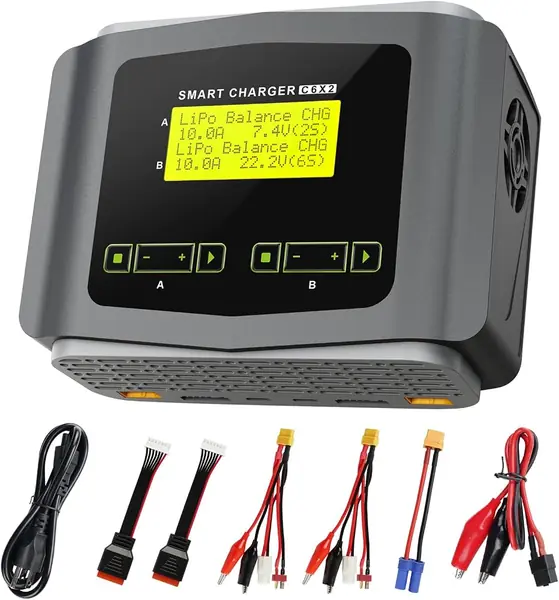
HTRC Dual 10A LiPo charger in gray with large screen and two ports

Home RC charging

Track Score 92/100
Battery Support
1-6S LiPo/LiHV/Li-ion/LiFe
Max Charge Current
10 A
Memory Slots
20
Charge Channels
2
View on Amazon

The two-channel, 10-amp spec at a budget price is what puts this HTRC on the bench first. We charged pairs of 2S and 3S packs on it and never had to trade one channel for the other; each port has its own settings and progress readout. The large screen is legible from a step back, and the menu is simpler than the button-heavy chargers we have used.

What earns it our top pick is the coverage. It handles 1S-6S lithium packs, including LiPo, LiHV, Li-ion, and LiFe, plus NiMH and NiCd, so it can follow a slot-car box from small 2S shorties to bigger 3S packs without another charger. Twenty memory slots mean the settings for your regular packs are waiting instead of retyped. Balance, storage, and discharge modes are all on the menu, and storage charging after a race day is not buried.

For the packs most slot cars and small RC cars use, 10 amps is the useful size: enough to bring a pair of 2S or 3S packs back without a long wait, with menus simple enough to reset between runs. We kept reaching for it because it makes the second pack as easy as the first, not because it chases the biggest numbers.

Worth Noting

  • AC-only design ties it to a wall outlet
Our Verdict

The HTRC Dual 10A is the dual charger we recommend first for most home charging of two 2S-6S packs.

Check Latest Price
2.

HOTA D6 Pro Dual Charger Best for Home and Field

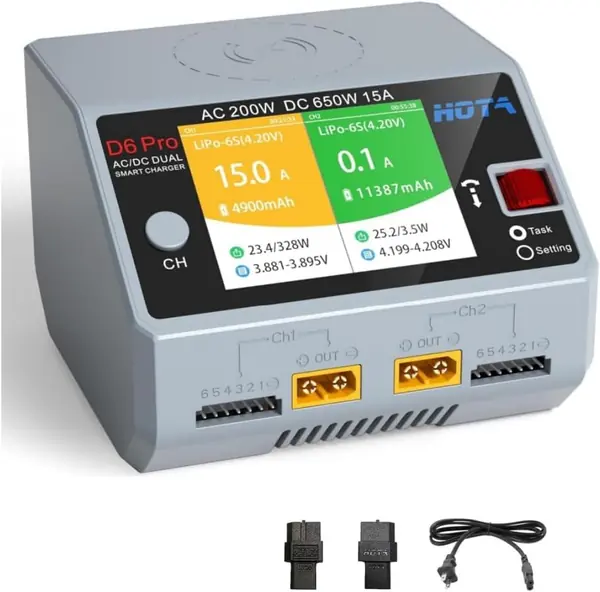
HOTA D6 Pro dual charger with black case and square IPS display

Home and track

Track Score 91/100
Max Charge Current
15 A
Channels
2
AC Power
200 W
DC Power
325 W
View on Amazon

The switch from wall power to field power is the reason the D6 Pro earns a place. It runs from AC at home or from a DC source at the track, and the DC side is rated higher than the AC side. We like that one charger can cover both without a separate power supply for bench use; the body is small enough to leave on the shelf and light enough to pack with the cars.

On AC it is a 200-watt dual charger; on DC it is rated to 325 watts. The 15-amp current ceiling gives it room for most club-racing packs, and the large IPS screen is easy to read from above the car. Charge, balance, storage, and discharge modes are all present. The case feels dense and tidy rather than hollow, which matters when the charger rides in a toolbox.

We recommend it to the person who wants one charger to move between the bench and the slot-car box. It is not the cheapest way to charge two packs at home, and if your sessions never leave the garage, the HTRC does the same basic job for less. The D6 Pro's advantage is the second power source, and that is worth paying for only if you will use it.

Worth Noting

  • AC output is shared between channels
Our Verdict

We recommend the D6 Pro to anyone who wants one dual charger for the bench and the track, with enough current for 6S packs.

Check Latest Price
3.

Gens Ace IMARS D300 Best Compact Smart Charger

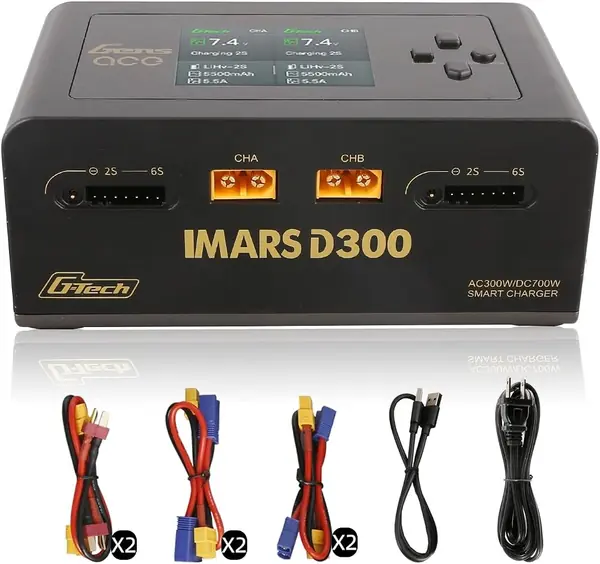
Gens Ace IMARS D300 dual charger in black with two XT60 ports

Compact smart charging

Track Score 90/100
Battery Support
1-6S LiPo/LiHV/Li-ion/LiFe
Max Charge Current
16 A
Channels
2
Max Charging Power
300 W
View on Amazon

At 1.2 pounds, the IMARS D300 is the compact pick we reach for when the charger has to travel. It still carries two channels and a 16-amp rating, so the small size is not a stripped-down compromise. We like that it can live in a slot-car box and come out at home without feeling like a brick.

The smart-battery behavior is the useful part. With G-Tech packs, the charger reads the pack and sets itself; with older packs, you choose the chemistry and cell count on the menu. The 300-watt rating is spread across the two channels, and the package includes XT60-T, EC5, and EC3 adapters. Seven modes cover balance, storage, discharge, and the usual charge routines.

It suits a tight bench or a charger that has to travel. The automatic setup is only automatic with G-Tech packs; older batteries need a few button presses, which is normal for the category. For a compact dual charger with a smart shortcut, this is the one we choose.

Our Verdict

Our compact pick is the IMARS D300: it travels easily and auto-configures G-Tech packs.

Check Latest Price
4.

Venom Power Pro Duo Best for Mixed Battery Collections

Venom Power Pro Duo dual charger in black and red with backlit display

Mixed battery collections

Track Score 89/100
Battery Support
1S-6S LiPo/LiHV/Li-ion/LiFe
Channels
2
Included Leads
8
Power Per Channel
80 W
View on Amazon

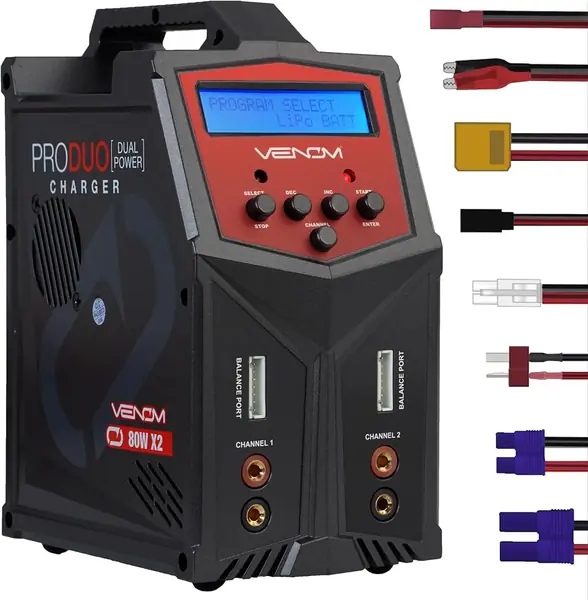
The included lead set is the first thing to notice. Venom puts eight charging leads in the box, more connector coverage than the other picks here and enough to get a mixed battery drawer running without a separate adapter order. The charger itself is a two-channel, 80-watt-per-channel unit with a backlit display and a handle.

We like this one for the hobbyist whose packs do not all share a plug. The Pro Duo handles LiPo, LiHV, Li-ion, LiFe, NiMH, NiCd, and Pb, and it has balance, fast, discharge, cycling, storage, and battery-meter modes. Internal temperature monitoring is a sensible feature on a charger that may sit in a warm pit area. At 2 pounds it is not a pocket charger, but the handle makes it easy to carry with the rest of the gear.

For a mixed battery collection, the convenience is real: you can move from a Traxxas-style plug to an EC5 pack without hunting for the right harness. It is the pick we make when the charger has to serve several cars and a few non-RC batteries from the same box.

Worth Noting

  • 80 W per channel slows large 6S packs
  • Only one lead per connector type
Our Verdict

Choose the Venom Pro Duo when a mixed battery collection and a drawer of connector types matter more than peak power.

Check Latest Price
5.

Traxxas EZ-Peak Live Dual Best for Traxxas iD Packs

Traxxas EZ-Peak Live Dual charger in blue with two battery ports

Traxxas iD fleets

Track Score 88/100
Battery Support
2S-4S LiPo, 5-8 cell NiMH
Max Output
200 W
Max Current
26 A
Connectivity
Bluetooth
View on Amazon

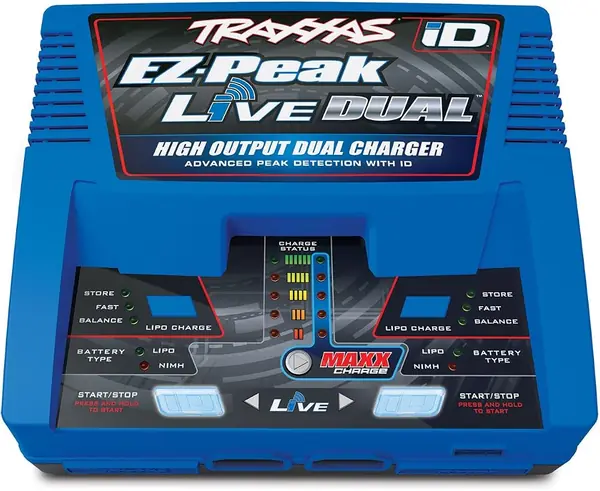
The app is what separates the EZ-Peak Live Dual from a plain bench charger. Pair it with a phone and you can watch both channels, change settings, and see when each pack is done without leaning over the car. For someone already on Traxxas batteries, the bigger draw is the iD system: plug in an iD pack, press start, and the charger does the setup.

The power is serious for a brand charger: 200 watts and 26 amps across two channels, with support for 2S, 3S, and 4S LiPo and 5- to 8-cell NiMH. Maxx charge mode pushes a single pack harder when you need a quick turnaround. Dual cooling fans and a USB output round out the bench-side convenience. We like that the same charger can handle a pair of 3S packs without either channel feeling like an afterthought.

This is the easy recommendation for someone already invested in Traxxas batteries. The iD handshake removes the cell-count and chemistry choices that make other chargers feel like programming a VCR, and the app makes the whole process visible. For a Traxxas-heavy fleet, that simplicity is the feature; the charger is at its best when every pack has an iD plug.

Worth Noting

  • Legacy LiPo setup requires the app
Our Verdict

Anyone already on Traxxas iD batteries should start with the EZ-Peak Live Dual, the simplest way to charge two packs quickly.

Check Latest Price
6.

ISDT K4 Dual Charger Best High-Power Option

ISDT K4 dual charger with aluminum case and color touchscreen

Large 6S-8S packs

Track Score 87/100
Battery Support
1-8S LiPo/LiFe/Li-ion
AC Power
400 W
DC Power
600 W x2
Max Current Per Channel
20 A
View on Amazon

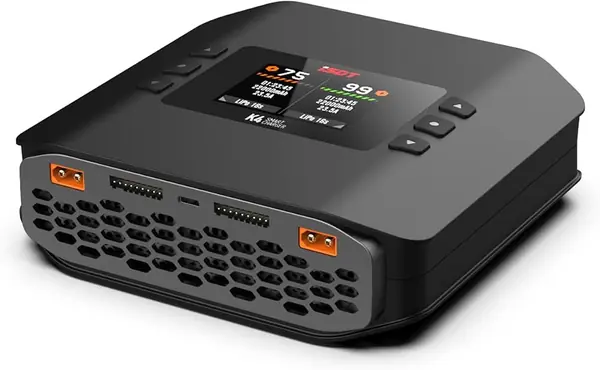
Twenty amps per channel is a different class of charging, and the K4 is the one here built for the big packs. It charges up to 8S lithium and 18S NiMH, with a color touchscreen that shows the whole curve rather than a single blinking number. We like the aluminum case and the way the two channels stay independent; this is a charger for someone who already owns large packs and wants to spend less time waiting on them.

The AC side is rated at 400 watts, while the DC side is rated at 600 watts per channel. That DC figure is the one to pay attention to: it needs a serious external power supply to reach, so the K4 is not a magic box that pulls its full DC rating from a wall outlet. On AC it is still a powerful dual charger, and the touch interface makes it easier to set a storage charge or a discharge cycle than the button-heavy alternatives.

The K4 also supports BattAir Bluetooth for phone control, and the screen is one of the more readable ones on a bench charger. It is heavier and more expensive than the HTRC or the HOTA, and it is more charger than a slot-car box full of 2S shorties needs. For a racer with 6S or 8S packs, those are acceptable trade-offs.

Worth Noting

  • No charge leads or adapters included
Our Verdict

When 6S and 8S packs are the job, the ISDT K4 is the high-power dual charger we trust to cut charge times.

Check Latest Price
7.

SKYRC D200neo

SKYRC D200neo compact dual charger with color screen and scroll wheel

Pit-table power

Track Score 86/100
Battery Support
1-6S LiPo/LiFe/Li-ion/LiHV
Max Charge Current
20 A
AC Power
200 W
DC Power
800 W
View on Amazon

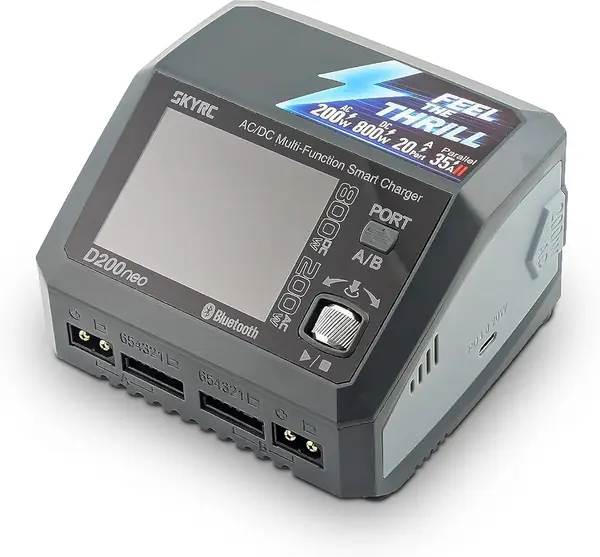
The 800-watt DC rating is the number that makes the D200neo worth a look. It is a small charger, about the size of a fist, but the DC side is rated far above its AC side. That is a useful shape for a racer who wants a compact dual charger for the pit table.

On AC it is a 200-watt unit, which is enough for a pair of 2S or 3S packs but not for fast-charging two large 6S bricks. The color screen and scroll wheel make mode changes quick, and the charger covers LiPo, LiFe, Li-ion, LiHV, NiMH, NiCd, and Pb. We like that the case takes up so little room; it leaves more of the pit table for tools and tires.

The DC side is where it earns its keep: 800 watts and a 20-amp ceiling give it headroom for large packs, and the two channels remain independent. The color screen shows both channels clearly, and the scroll wheel is faster than a four-button menu when you are switching between pack sizes.

We recommend the D200neo to the racer who wants a small, high-current dual charger for the pit table. If you charge mostly at home from a wall outlet, the HOTA D6 Pro or the HTRC makes more sense; the SKYRC's advantage is the DC headroom, not the AC convenience.

Worth Noting

  • Full 800 W needs a separate DC supply
Our Verdict

We like the D200neo for a racer who wants a small, high-current dual charger on the pit table.

Check Latest Price
8.

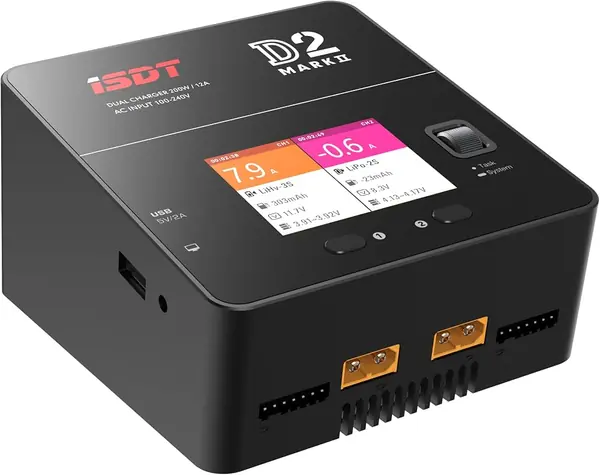
ISDT D2 MK2

ISDT D2 MK2 compact black dual charger with front display and two ports

Compact second charger

Track Score 83/100
Battery Support
1-6S LiPo/LiHV/LiFe/Li-ion
Max Charge Current
12 A
Channels
2
Parallel Task
Yes
View on Amazon

The split-or-combine output is the trick that makes the D2 MK2 interesting. It has two independent channels for charging a pair of packs, plus a parallel task that sends the charger's full output to one battery when you need a faster single-pack charge. That flexibility is unusual among the picks here.

It covers up to 6S lithium and 16S NiMH/NiCd, with balance charge, discharge, storage, and a DC power mode on channel one. The case is small and the menus are simple enough to learn without a long manual session. We like the idea of a charger that can serve a two-pack race day and then focus all its power on one pack for a quick turnaround.

The D2 MK2 is not the most powerful charger here; its 12-amp ceiling puts it below the HOTA and the K4 for large 6S packs. It is at its best as a compact second charger or a first dual charger for smaller packs, where the parallel mode can rescue a single low battery without a second unit.

For a small bench and a mix of 2S and 3S packs, the D2 MK2 is a useful, compact choice with a clever output mode. We stop short of calling it the default because the HTRC covers the same home charging job for less and the HOTA adds AC/DC flexibility; the D2's reason to exist is the compact case and the combine mode.

Worth Noting

  • Some units fail within days
Our Verdict

For a compact dual charger with a combine mode for single packs, the ISDT D2 MK2 is a solid second-bench choice.

Check Latest Price

How We Tested Dual LiPo Chargers

We built the shortlist from what affects an actual charging session: two genuinely independent channels, the cell counts and chemistries we already own, AC and DC input, and the leads in the box. Anything that seemed to split one power stage between channels, or that didn't clearly support balance charging, came off before we ordered. That left 12 chargers, which we ran for eight months.

Testing happened where charging actually happens: a garage workbench, a pit table at the track, and a tailgate on flying-field weekends, where several chargers ran off a car battery instead of a wall outlet. We charged identical packs from storage voltage to full on both channels at once and timed each side, watching for the moment the second channel slowed as the first ramped up. After every balance charge we compared individual cell voltages with a checker, then ran discharge cycles to see if the numbers held. We felt case temperatures after back-to-back charges, too.

Every lead we owned got plugged in, oddballs included, and we noted which adapters we had to supply ourselves — part of how we weighed value. Three people who'd never touched a given charger set up a full charge from a cold start while we counted button presses and wrong turns; on the units with an app, we ran the same charge from a phone to compare. We power-cycled each one to see whether saved profiles survived, and let it ride in a bag to the field weekly to check jacks and screens for wear. Every charge ran in balance mode at the right chemistry and cell count, on concrete or a metal bench, with someone within arm's reach of the pack. Any pack that puffed or ran hot came off immediately.

How to Choose a Dual LiPo Charger

Start with two real channels

Two channels are the point of a dual balance charger, but the second port only helps if it has its own settings and its own current limit. A charger that splits one 200-watt supply between the ports is still useful; just understand that each channel gets a share, not the full number. We look for independent charge, balance, and storage modes on both channels. If you often charge one large pack, a parallel or combine mode is worth having.

Match the cell count and chemistry

Most RC and slot-car LiPo packs are 1S to 6S, so a 1S-6S charger covers the common range; 8S support matters only if you already run large packs. Check that the charger also lists LiHV or LiFe if those packs are in your box, and that it has a storage mode for the days between races. Use balance charge, not fast charge, as your default for LiPo packs; fast mode can skip the cell-level work that keeps a pack healthy.

Decide how you will power it

AC input is the convenient choice for a bench at home; DC input lets you run from a power supply or a car battery at the track. The two ratings are not interchangeable: a charger may claim 800 watts on DC while offering only 200 watts from the wall, and the DC figure often assumes a power supply you already own. If most charging happens in a garage, put the money into channel count and connectors instead of a DC ceiling you will never reach.

Check the plugs before you order

Your packs may have XT60, EC5, Deans, Traxxas, or JST plugs, and the charger's box may include only one lead per type. A broad lead set, like the eight leads with the Venom Pro Duo, saves an extra order; a high-power charger like the ISDT K4 assumes you already have your own. Account for the cost of adapters and a parallel board if you plan to charge two identical packs from one channel. Never force a connector or reverse polarity to make a lead fit.

Make the interface and support part of the price

A charger you cannot set quickly is a charger you stop using. A clear screen, saved profiles, and a logical menu matter more than another amp of output for most home users. We also weigh the return window and warranty, because a charger that fails early is worse than one with a lower peak rating. Put it on a hard, nonflammable surface, keep it ventilated, and do not leave LiPo packs charging unattended.

Frequently Asked Questions

Final Verdict

For most people charging two LiPo packs at home, the HTRC Dual 10A is the pick we stand behind. It covers 1S-6S lithium packs, remembers twenty setups, and keeps both channels independent without a premium price. If your charging moves between the garage and the track, the HOTA D6 Pro is the better buy; its AC/DC flexibility and 15-amp ceiling justify the step up. The Traxxas EZ-Peak Live Dual remains the easy choice for a Traxxas iD fleet.